
We have a lot of stuff, yet our lives are empty.
Fashion can communicate what’s going on in society. One way is more literal by what we wear. Another is more abstract and philosophical in messaging, in storytelling, that makes us think about the world we live in, about the choices we make, and it makes us question, or at least talk about, those choices and world issues. And, yes, we can wear that fashion, too.
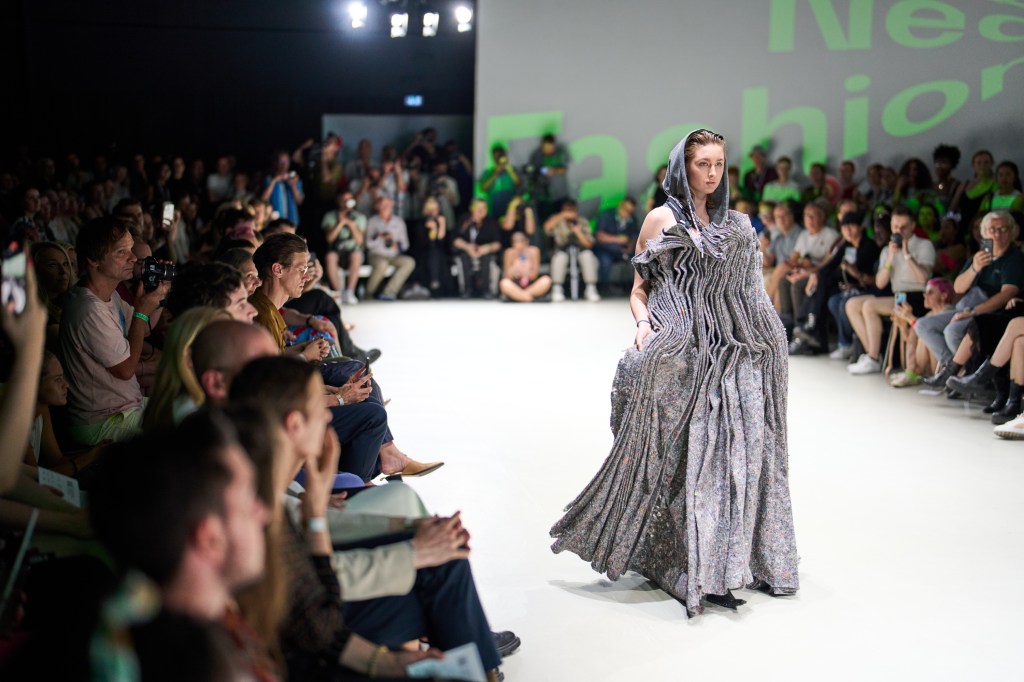
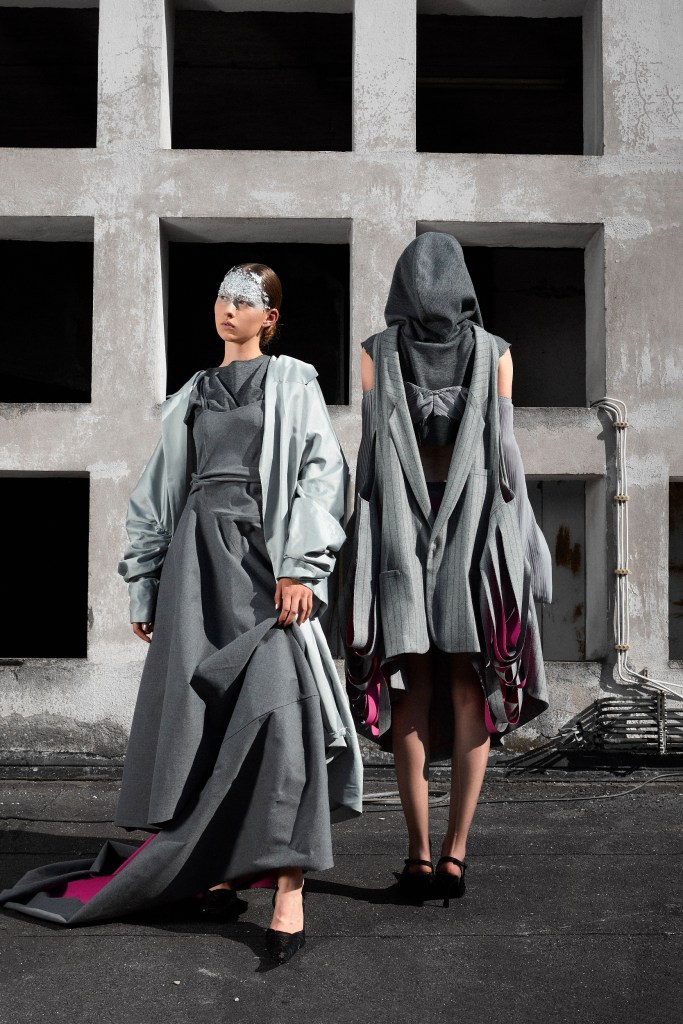
Designer Paula Lessel, a recent graduate of Pforzheim University in Germany, created Fashion for an Empty World, an example of how fashion can visually communicate the state of affairs. There are six looks in this collection which examine the current state of fashion. The current state, as we know it today, is fast, mediocre, and more of the same—just a reiteration of what we already have.
According to data from Roundup.org, between 80 and 100 billion new clothing garments are produced globally every year. We collectively have more clothes in our closets than the 8 billion global population. And consider, across the globe, clothes that are not in closets such as: new clothes sitting in stores to be purchased; secondhand clothes in secondhand markets; secondhand clothes in route to other countries; clothes discarded in the landfill; and clothes in the supply line—from fiber to fabric, to cut-and-sew, to finishing, to packing, to shipping, to in store.
Lessel, an award nominee for Berlin Fashion Week’s Neo.Fashion.2023, is part of a new generation of designers who refuse to give into a system that generates excess and waste, and consumers whose senseless consumption habits have no beneficial value. She frames up the current state of fashion as a frozen moment in time “where overflow, excessiveness and abundance implode and turn into emptiness and meaninglessness.”

Inspired by a quote by Peter Sloterdijk, the collection plays out in a grey area, in which she utters, that it always makes itself noticeable when “order fails without chaos being welcome to ensue.” The collection negates the general notion that fashion creates newness and instead states that it rather produces new variations of what is already there. She further explains that this ‘grey area’ is a ‘transition stage’, call it chaos, if you will, where the industry and consumers have an opportunity to let go of old systems and old habits for a more meaningful future:
Sloterdijk explains that grey areas are the result of excessive opportunities, overflow of information and exhaustion of resources. Faced with this overwhelming abundance we show too little flexibility for what may be the unforeseen results of those systems that we have built. Instead, we rely too heavily on what has already been in the past, rather than what could become in the future. We are missing out on new and surprising chances.
I view this grey area as the ‘in between’, a transition stage. To welcome new ways of consuming, of shaping our narrative, of creating art and culture we will have to stop relying on our old habits. Letting go of what we already know may seem chaotic and scary. But order failing and chaos being allowed to ensue will allow us to rearrange and build something new and more meaningful.
Lessel continues by revealing her own plans for a new order of responsible fashion, “after taking a close look at the current state of our overfilled, yet empty world, my plan is to further engage in the search of finding different ways to create fashion that is responsible, ages beautifully and challenges our perceptions.”
By promoting a sustainable design practice, she believes aesthetics are as important as the practicality of a sustainable system. She says, “the approach of aesthetic sustainability needs to be more included in our discussion and practices concerning sustainable fashion. Aesthetics and practicality should not be seen as mutually exclusive. We just may need to redefine these terms.”
Fashion for an Empty World offers purpose, beauty, with an innovative eye in the use of deadstock materials. She fused a ‘prudish’ traditional grey wool suiting fabric with a pink material (for the underside) turning it into a double-face fabric. Using it as a symbol to tell her story, she says, “when we crack open the grey area, we will see a future that is rosy!”
Other materials consisted of pieces made from painter cover fleece, which Lessel characterized as cheap material that “is commonly made from discarded and shredded clothes, it symbolizes this moment of everything and nothing, excess and emptiness at the same time.”
A glitchy tartan print on gabardine, subtlety adds a sophisticated pattern with a hint of pink for a body of work that purposefully reads grey. Nicely done.


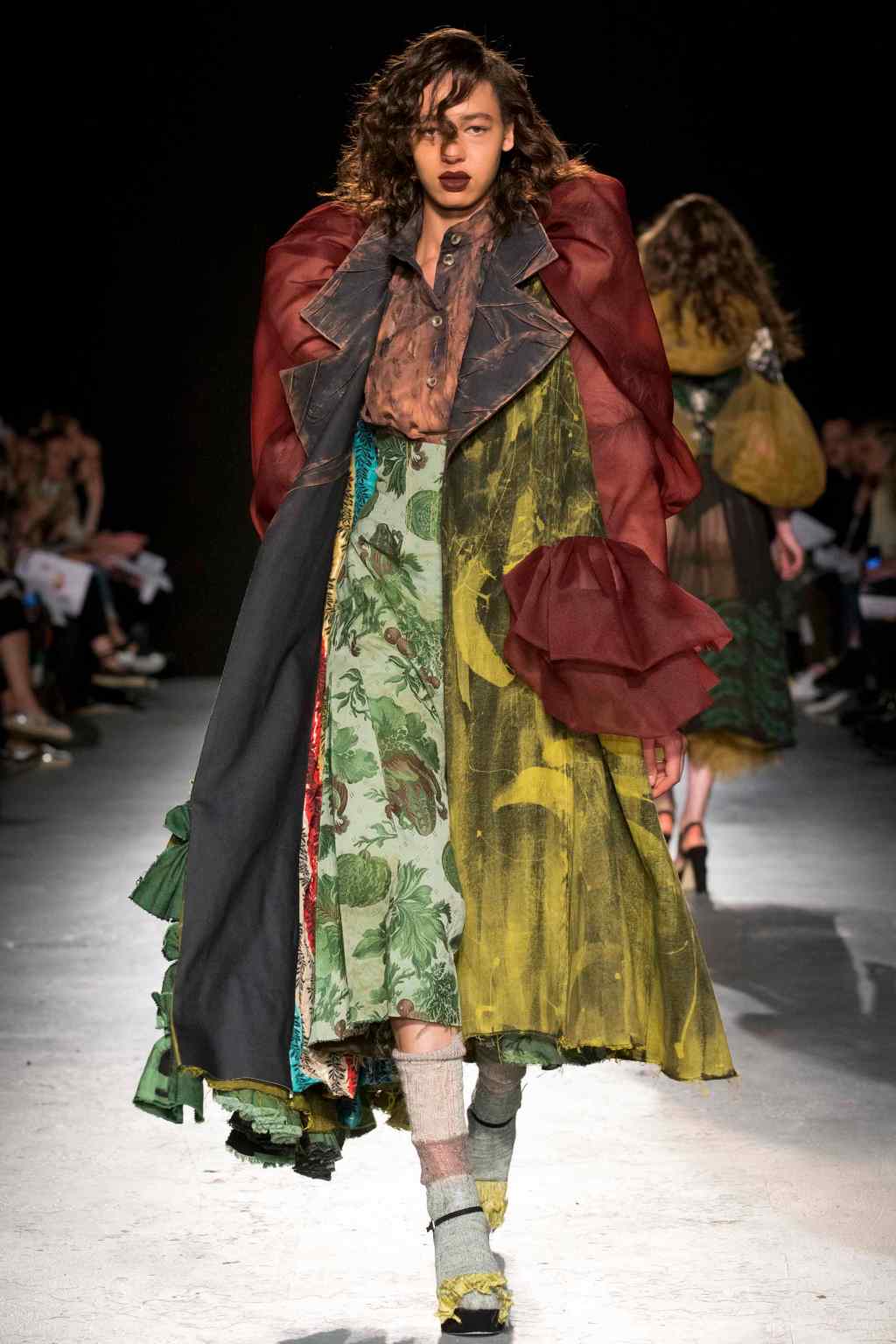
The composition and construction are sculpturally stunning, very dramatized – with unexpected cuts, lines, shapes, and texture, plus a few surprises as you view the front and back of each look. There is an artistic oddness and beauty all in one, visually exciting to look at. Her storytelling of ‘excess and emptiness’ runs through each look, right down to the names of the looks—such as Backwards-Pants, Breakup-Dress, No one-Hood, and Forever Empty-Bag. Even the shoes she created, named Long Heels, show her inventive edginess, another special detail amplifying the story.
When asked about Long Heels, once again inspired by a Sloterdijk statement, Lessel chronicled how design can be overplayed without a ‘why’, a purpose, and context. She says, “when brainstorming about what kind of shoes would be appropriate for the collection, I was inspired by another Sloterdijk statement about modern design often forgetting about context and connotations and thus being overdone to a point of meaninglessness.”
With “meaningless” at the core, she continues with remarks reflecting today’s fashion cult of making new fashion for the sake of making new fashion as rapidly and repeatedly as possible. “In the context of clothing, we tend to create fashion for fashion’s sake and for newness’ sake. It was clear to me that the shoe would have to embody this type of pointlessness; chaotic, but not yet new, not being made for human beings, but for a stylish look. They would have to be elegant, but impractical and a bit clownish.
The pointlessness of Long Heels makes the point (pun intended) as does the collection. You get the point of extreme, useless consumption; how much do we really need of meaningless stuff? She says, “each look visualizes an exaggeration and an exhaustion of what we already know. In this way, seams turn out too long and will not fit their counterparts, gigantic dress shirts are forced onto the human body and overly long skirts cause wearers to trip over them. Fashion for an Empty World may not be a solution to our overfilled-empty world, but it is a more curious look at the colorfully grey noise we experience.”


Fashion for an Empty World is a skillful execution of a socially relevant perspective on fashion that prompts an intelligent dialogue on its contribution to art, culture, and sustainable practices.
Congratulations Paula!
Feature photo: Berlin Fashion Week July 2023, Neo.Fashion.23, Paula Lessel, Fashion for an Empty World, Look 3, No one-Hood, Masse-Dress, Long Heels | Photo by robert-schlesinger.com, @robertschlesinger s for Neo.Fashion.23
 E D G E