Two days after the 2024 U.S. election, with all of its racism and male toxicity, Mai Ide’s be nice + kind to yourself installation opened at Littman & White Galleries in Portland, Oregon. Exhibition visitors entered into a nurturing and healing space. At the opening event, a meditative ikebana ceremony was created while Ide and another dancer performed a pas de deux to music. They held large fabric pieces, slowly wrapping each other with great care and love. Behind them hung a floor-to-ceiling textile screen, titled HAHAHA; Language Barrier. It was sewn from traditional obi sashes cut apart and re-stitched into the letter shapes “H” and “A” that also resembled vaginal forms. This bold wall of laughter constructed from obi, the traditional binding belt for a kimono, dominated the room as a powerful metaphor for energy released from immense tension. Its message, to overcome misogyny by ridiculing it, offered a perfect antidote for post-election malaise. Both the dance and ikebana ceremony symbolized the resilience possible when women take care of each other.

As a Japanese woman living in the United States, Ide encounters a lot of assumptions and misunderstandings about being an Asian female immigrant. In response to this, there are many elements at play in Ide’s exhibition relating to gendered garments, cultural attitudes, language and translation, and personal agency. At first glance, the expertly stitched and exquisitely sourced fabrics appear stylish and beautiful. Look deeper and they reveal themselves as artworks using the language of fashion to explore reconstructed identity, boundary-challenging items of dress, and thought-provoking experiences probing gender and racial stereotypes.

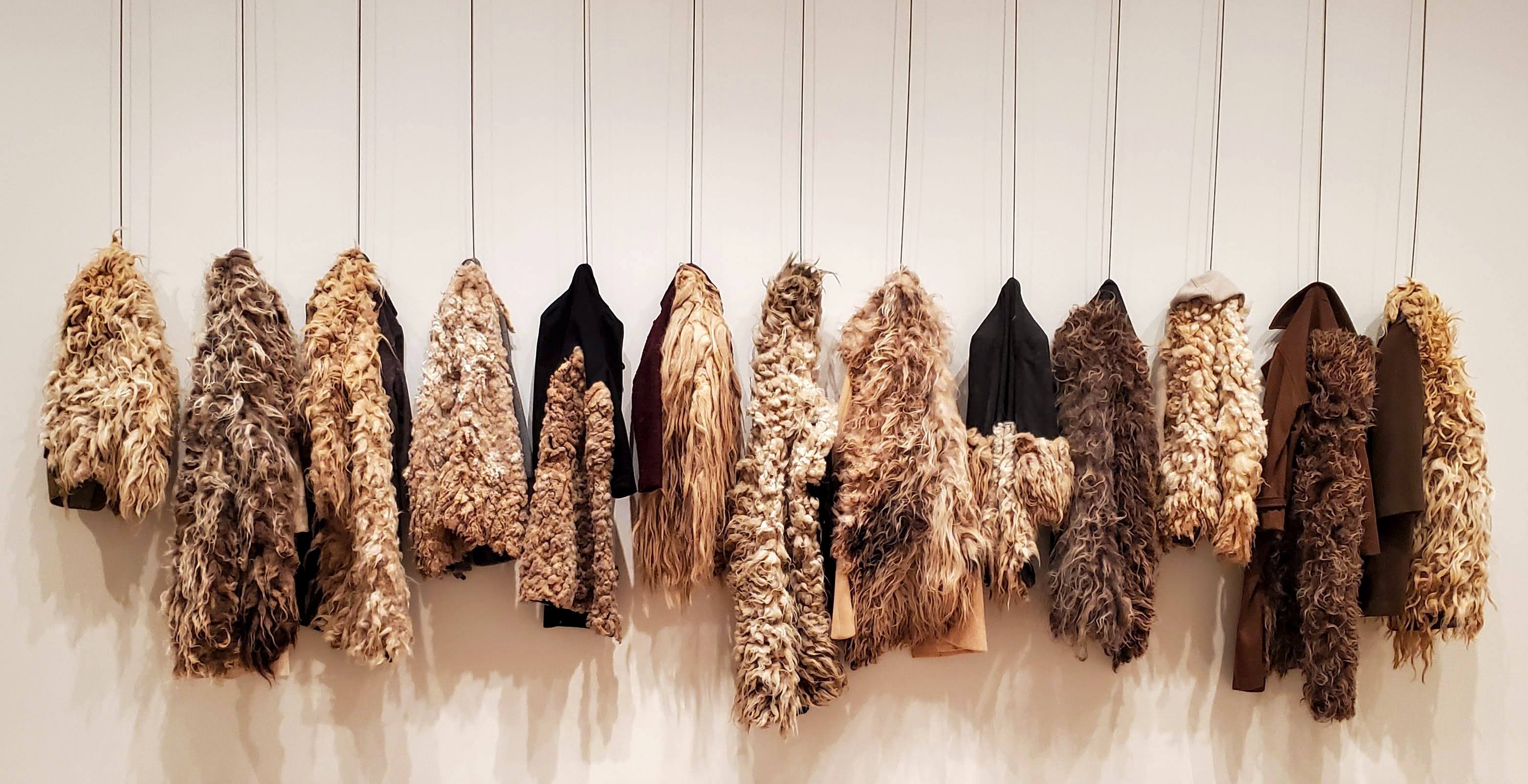
The exhibit features hybrid outfits suspended from iron arcs that serve as hangers. With hoods patterned from Western outerwear yet constructed flat, like in Japanese kimono, the jackets defy categories and complicate expectations. Large vertical stripes help define a jumpsuit as male workwear but here they are paired incongruently with an elegant hanten (jacket). Tiny details such as miniature doll hands, metal coins and dice are handstitched onto traditional Japanese printed fabrics, teasing the viewer to decipher their meaning. Below, cloth shoes held together with sashiko stitches unexpectedly depict the toes hidden inside. The whole effect is unsettling and enlightening as the viewer navigates cultural aesthetics that cross between Japanese and Western ways of dressing. Interpreted through the artist’s own visual language, these pieces have deeply engaging impact.

Elle Hygge Photography
The needle is used for repairing damage.
Louise Bourgeois

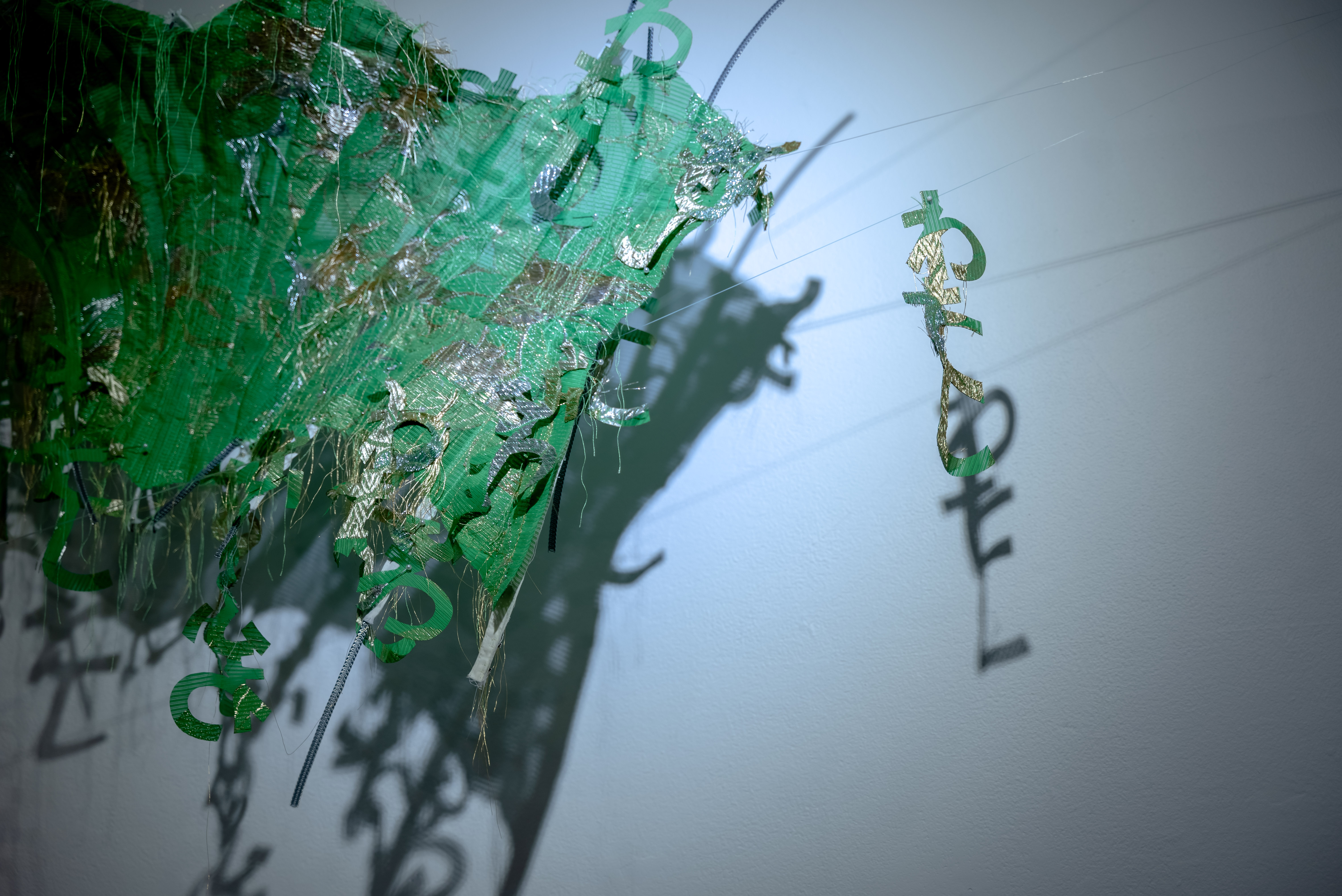
Across the room, four intricately-sewn corset shapes have opened up to become wings that seem to fly upward. Similar to the obi in Japanese dress, the corset serves as a garment of restraint for women in Western fashion history. Ide’s artworks subvert that representation with defiance and provocation. One winged corset is sewn from upcycled chemical sacks that warn in printed Kanji and Hiragana, “Toxic, do not touch!” Its double entendre refers equally to physical and social dangers, as well as to the potency of what is contained inside.
Ide often repurposes found garments and textiles in her work, deconstructing them to arrive at a new perspective. For another corset piece, she cut up an obi given by her mother as a wedding engagement gift, contradicting its traditional significance of conforming to convention. The artist redefines relational dynamics embedded in clothes by stitching her truth. Words literally spill out of these corsets, dangling on threads, irrepressibly interrogating the status quo and the patriarchy. Countering the stereotype of a submissive Asian woman, the corset’s steel boning is intentionally exposed, emphasizing its strength. Sashiko stitches themselves connote another symbol of strength and healing. When the needle stabs worn-out cloth, it is transformed into a new, sturdier fabric.
This is revolutionary work performed stitch by stitch. As the famous artist Louise Bourgeois, who also practiced stitching, said, “The needle is used for repairing damage.” This exhibit attests to an artist reinventing themselves in relation to others, and imagines a more inclusive world order that has healed its hatred. Ide proposes to reach this goal by providing care and offering a powerful expression of her unbounded spirit.
@maiidepdx | maiide website
Feature image: Corset Series #3 Watashi (detail), 36″ x 14″, Mai Ide, be nice + kind to yourself installation, 2024, Littman & White Galleries, Portland, Oregon. Curated by Naomi Nguyen and Simeen Anjum. Elle Hygge Photography