
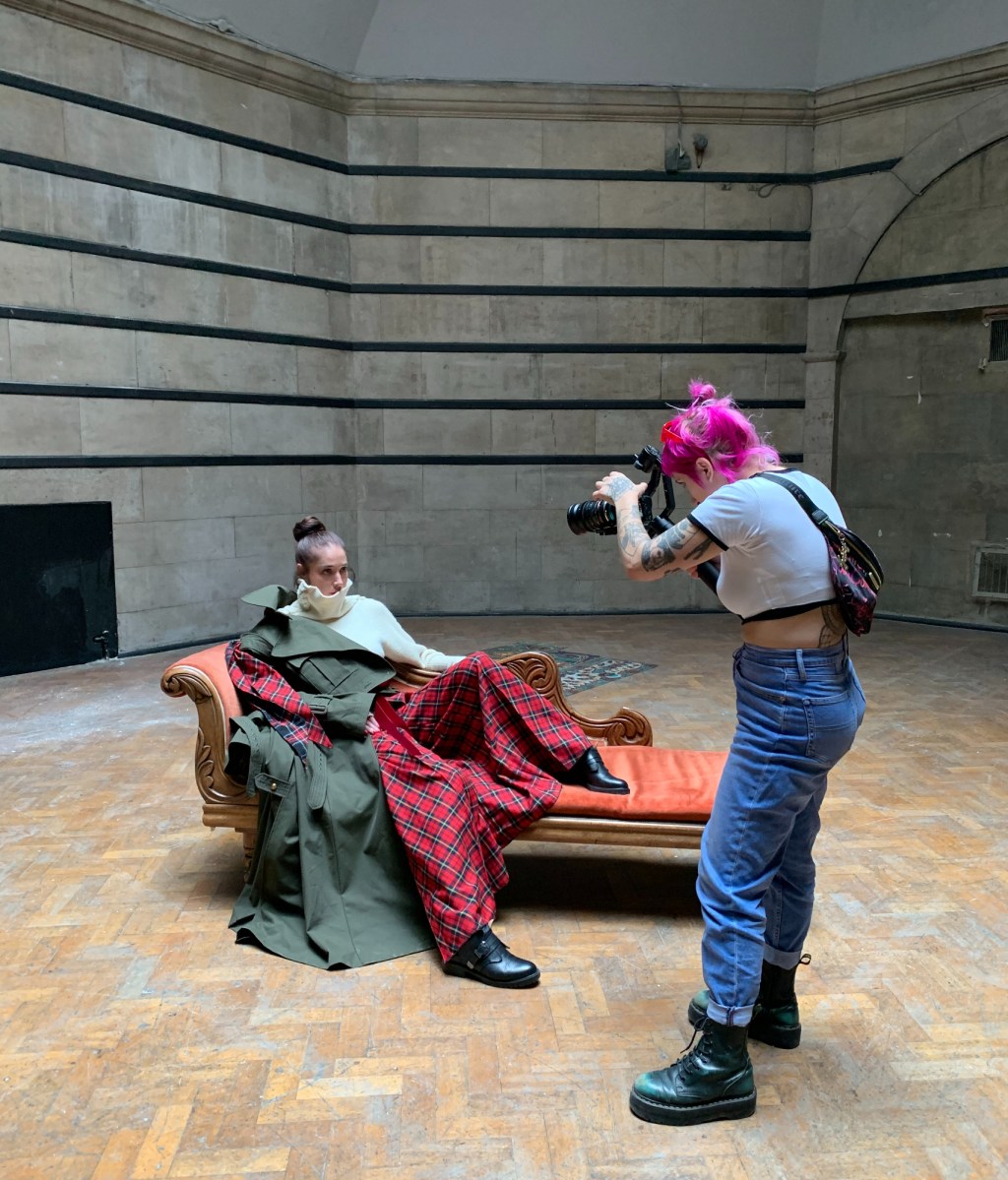
Surrounded by the sounds of war, fashion emerges as a strong cultural mark—an encouragement for a brighter future. Ukrainian designer, Yevgeniya Melnyk, knows this first hand.
Creating a meaningful body of work starts with an interest, an influence, an idea, or passion that inspires a vision and composition, fueled by research and study. Influenced by Russia’s invasion of Ukraine, Ukrainian designer, Yevgeniya Melnyk, created EIWWI, which combines two of her interests that are of historical fashion significance, Queen Elizabeth I and World War I.
Setting the tone for this body of work, the following video, directed by Kassandra Powell, artistically manifests how war-torn communities come together creatively to convey that culture still exists. “I had a chance to work with a talented filmmaker on a short fashion video which reflects the wartime atmosphere in Ukraine,” says Melnyk about the creative collaboration illuminating the political and war related subject of her collection, EIWWI.
Ukraine Culture and War Influence
Before we get to the story and importance of EIWWI, I’d like to put the development of this body of work into context. Melnyk reminds us that this war started in 2014 when Russia annexed Crimea, and has been an influential factor in her work and Ukraine’s cultural apparatus: “I created this collection in 2020, before the full-scale invasion of Ukraine by Russia. However, it is important to point out that my country had already been at war with Russia since 2014 when Russia annexed Crimea and the eastern provinces of the country. Accordingly, my collection was influenced by these developments.”
Experiencing EIWWI, as with any meaningful art, can evoke emotion, as this work achieves. Creativity never dies and its spirit is never lost, in fact, during conflict, unrest, and uncertainty, it reaches new heights of exploration, contemplation, and expression. Melnyk goes on to say that the war is “influencing every aspect of social and cultural life in Ukraine. This transpires particularly through entertainment, music and art. This collection reflects these tendencies, but it also emphasizes the importance of a strong spirit in dark times.”
Hailing from Ivano-Frankivsk, Ukraine, Melnyk currently lives in two cities – London and Lviv, Ukraine. With the ongoing conflict in her country, Melnyk is pertinacious in basing her brand in Lviv, her home country, in spite of the horrors of the war. She says, “I am setting up my brand in Lviv as I want it to be a Ukrainian fashion brand and my plan is to employ Ukrainian professionals giving them the opportunity to use their skills, work and earn in their home country.”
Lviv is in western Ukraine, about 43 miles from the Polish border, which Melnyk describes as a city in transition since the invasion: “Lviv was always a vibrant and cultural spot, but due to the war it took over more responsibilities sheltering numerous businesses and startups relocating from the rest of the country. It turned into the hub of the thinkers and creators from all over Ukraine, offering the opportunity to connect with industry insiders and like-minded artists like never before.”
World War I Influence
As an artefact of our culture, fashion can be seen through the lens of social anthropology, and through this lens Melnyk describes the historical significance of her two subjects, WWI and Queen Elizabeth I: “World War I as the first mechanized conflict and the one which had set long-lasting trends in modern fashion. And second, the role of strong political leaders in setting fashion trends.”
The influence of military dress in fashion dates back to Coco-Chanel’s military-style pockets on women’s jackets. Designed for uniformity and to help soldiers to see and be seen on the battlefields, pre-WWI military uniforms were boldly hued, ornamented-distinguishable uniforms. WWI, the first truly modern war with the use of advanced machinery—mechanized warfare—changed that. Inconspicuous subdued blues, greens, greys, and khaki colors dominated the military ready-for-battle wardrobe.
From her research, Melynk, with an engineering background who studied fashion design in London, asserts how the color of khaki and medical advancements (that assisted wounded soldiers) influenced her designs:
World War 1 was the first war of industrial scale, and the British were the first to use khaki color to conceal their forces on a battleground. The word “khaki” comes from Urdu and Persian meaning “earth” or “dust”. British first adopted it in India. Scottish soldiers went to battlefield wearing khaki jackets and their clan kilts. To protect them from dirt the soldiers used khaki-colored kilt covers.
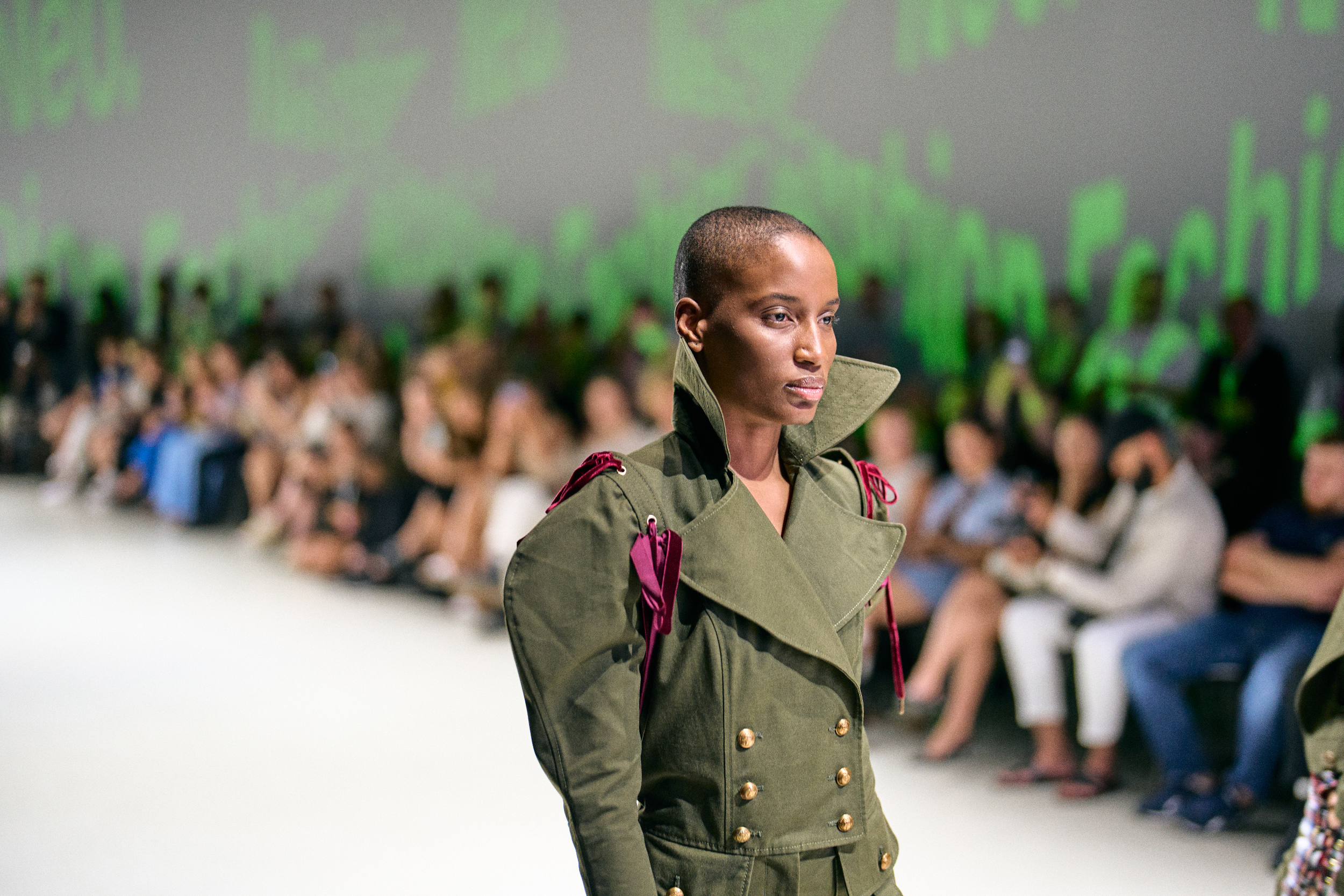
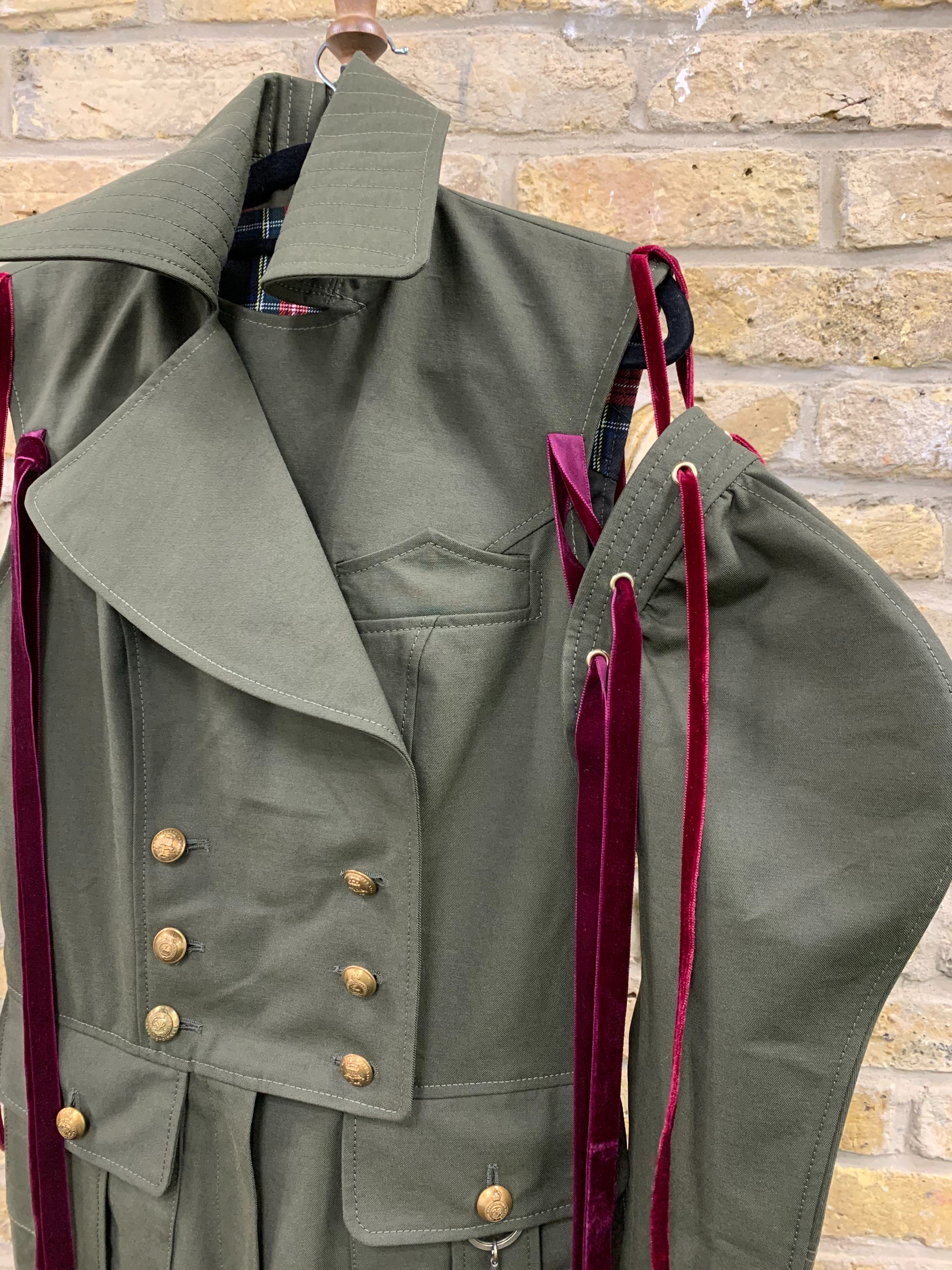
Moreover, many medical advances were made during WW1, such as the facial prosthesis technique that was developed to help wounded soldiers reintegrate into society upon returning from war. One example of detail inspired by my research of WW1 was using the lacing of the corsets and trousers in my collection as a reference to the facial prosthesis.
Metal zippers, Trench coats, Bomber jackets or Flight jackets, created by the US Army Aviation Clothing Board in 1917 to keep WWI pilots warm in the uninsulated, open-air cockpits of the early fighter planes, came to prominence during this time. One use of the metal zipper was as a money belt fastener for WWI U.S. sailors. Melnyk notes that “those and many other war related inventions are now contemporary and functional fashion staples.”

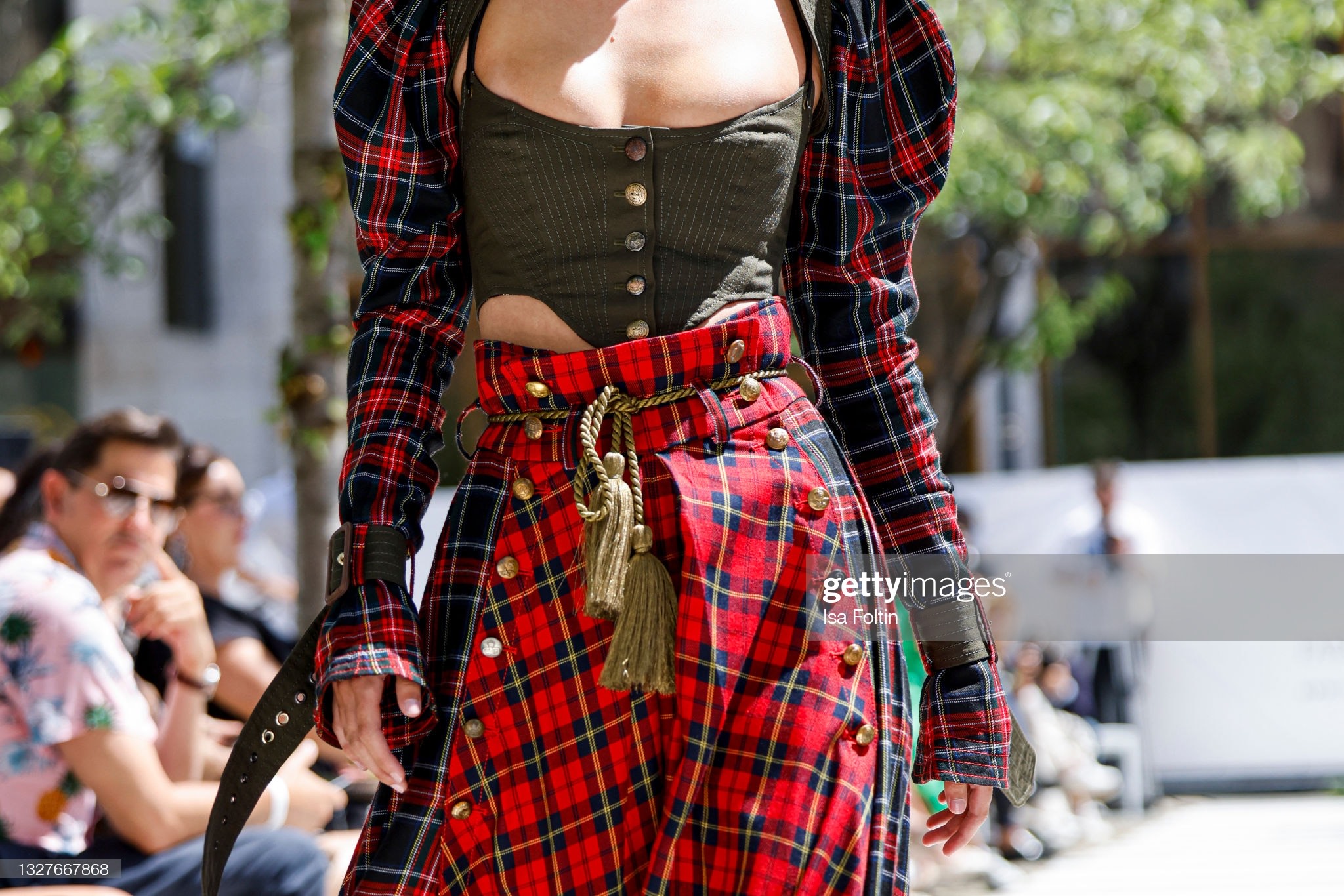
Her materials are consciously curated, capturing the authenticity of her story and practicality in its execution. She used genuine vintage WWI British uniform buttons, as she claims were “hunted down at vintage markets.” She reveals that the buttons are the “jewels of the collection” and applies a creative nuance worthy of the look, “I intentionally combined different buttons on one garment giving that extra touch of uniqueness to each piece. Some of the buttons even have patina spots, which makes them even more special and exclusive.”
Scottish tartans were used across the collection in honor of the Scottish soldiers who proudly wore their clan kilts (under their khaki kilt covers). Waterproof polycotton khaki material was chosen for its function and aesthetic.
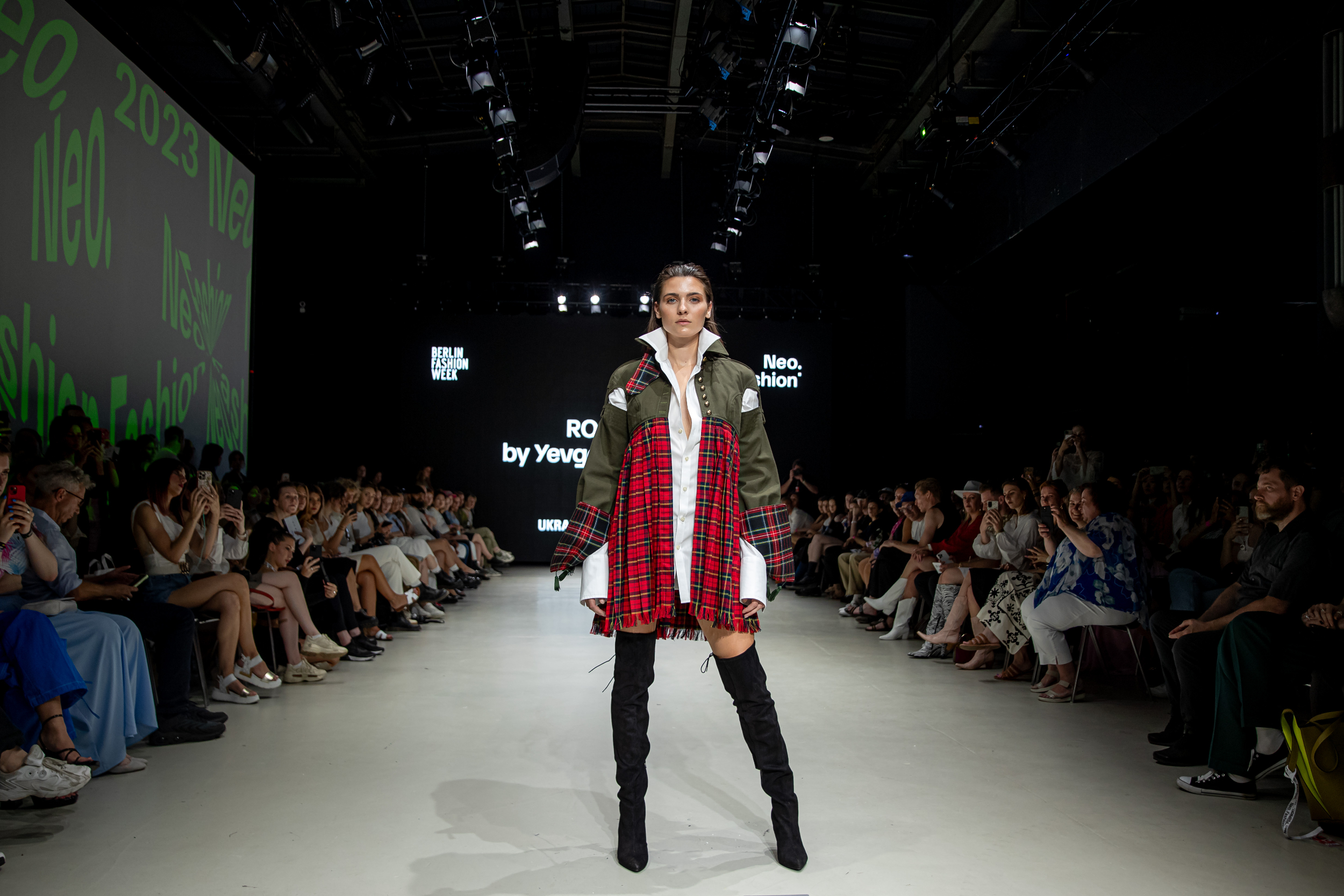
Melnyk’s two-part message conveys the empowering effect fashion has on our culture. In the first part of her story the British military uniforms were transformed based on the need to camouflage the soldier’s presence on the battlefield. Cloth, design, and color were the catalyst in constructing a practical solution for a soldier’s uniform in combat. Since then, the popularity of military influence in fashion has never waned.
Queen Elizabeth I Influence
The second part of her story is the rule, reign, and power of Queen Elizabeth I. Melnyk admires her strength, leadership, political achievements and influence she had on fashion. She says, “Queen Elizabeth I successfully ruled the Empire, immensely influenced international politics and history, set strong cultural trends, including art and fashion … became a style icon: the position she enjoyed to the same extent as being a political leader.”
History documents the style icon she was with her love of fashion and jewelry. As chronicled by Royal Museum Greenwich, she was very conscious of her appearance. She knew that her actions and image formed her identity, which in turn became a symbol for England. During her reign, Elizabeth’s image was carefully engineered to convey wealth, authority and power, both at home and abroad with fashion at the center.
Queen Elizabeth I used the power of fashion to not only transform her own identity, but through sumptuary regulations, transformed the identity of the society that she ruled, by dictating the colors and fabrics that people were permitted to wear based on their social rank and wealth. She is known to have had 628 pieces of jewelry and when she died, over 2000 gowns were recorded in her wardrobe.
From her research, Melnyk divulges some details that influenced the design of her work: “Elizabeth herself was tall and lean, however her charisma made her look desirable for fashionable women. Elizabeth promoted flat chest corsetry, cinched waist, puffed sleeves. Dresses had been worn for many years due to the cost and time it took to make them. Sleeves however wore off (especially at the elbows) much faster than the rest of the garment so they were often replaced with new ones. This is why in the paintings of that period sleeves were of yet of different color and pattern than the dress. Elizabeth used this as an opportunity to alter her garments with new sleeves, bodices and collars and create new looks.”
In Melnyk’s design you can see the influence of the sleeve detail and ‘flat chest corsetry’. She says that “the velvet ribbons are used to attach sleeves and lace the corsets, velvet being one of the most desired fabrics among European royalty and nobility of the 16th century.”

In conclusion, Melnyk remarks about her collection and what fashion represents:
Fashion can be both sophisticated and functional.
Women can retain femininity while feeling empowered without compromising their comfort and freedom of movement.
I am forever fascinated with the flexibility and omnipresence of fashion, it adopts social, cultural and industrial innovations, carries information, allows self-expression, empowers, protects, amuses. Fashion is as dynamic and complex as human psychology.

Congratulations, Yev Melnyk!
Feature Photo: Yevgeniya Melnyk, “EIWWI”, 2020, video director Kassandra Powell @thekassandrapowell, dancer Rose Alice, @rosealiceofficial, while filming in London | photo by Yevgeniya Melnyk
 E D G E