

Portland, Oregon-based abstract painter, Erik ReeL, and Ventura, California-based fashion designer, Narci Lee, combined their ecological ethos and improvisational instincts to create a work of art out of discarded textiles, designed to be worn (and talked about) as a socio-ecological statement.
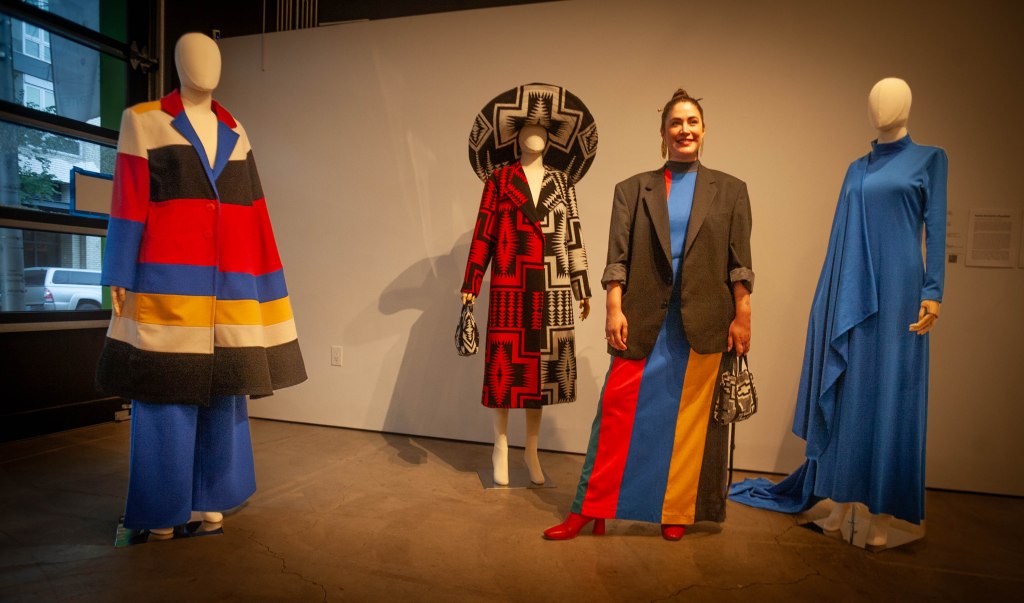
The work of art, a three-piece ensemble (coat, dress, and duffel) of painted deadstock futon covers by ReeL, upcycle designed by Lee, titled Vivi Ann, is exhibited in What’s So Lovely About the End of the World?, 28 August – 28 September 2023 at Portland Oregon’s world headquarters of PLACE, winner of the Architecture MasterPrize, Landscape and Urban Design, Firm of the Year.

What started as a conversation in November 2022 on how to keep unwanted textiles out of the landfill, ended up in a start-stop-evolve-improvise process resulting in a ‘conversational’ piece worthy of the hot topic of the day – the climate.
What’s So Lovely About the End of the World? examines ecological thinking, and how artists are diverting material waste from a heavily polluted environment of which fashion is the planet’s third largest polluter.
Keeping textiles out of the landfills reduces toxic gas emissions.
Environmental Protection Agency (EPA) states that municipal solid waste (MSW) landfills are the third-largest source of human-related methane emissions in the United States, accounting for approximately 14.3 percent of these emissions in 2021. The main source of textiles in MSW is discarded clothing. The methane emissions from MSW landfills in 2021 were approximately equivalent to the greenhouse gas (GHG) emissions from nearly 23.1 million gasoline-powered passenger vehicles driven for one year or the CO2 emissions from nearly 13.1 million homes’ energy use for one year.
We see the importance of skipping the landfill and creating art, repurposing, reimagining, upcycling, extending the life-span of textiles.
As curator of the show and a proponent of zero-waste practices and circular systems, I had an intimate involvement in the making of Vivi Ann, of which Lee explains, “is my Art Warrior from The Vitruvian Man.” The E D G E fashion intelligence platform, and my vision of fashion’s future, allowed me to offer unique guidance in the development of this work.
To create the work, Lee, a designer who specializes in upcycling, suggested deadstock from futon covers for its structure, drape, and ability to shape. It also served as a blank canvas for ReeL to paint his signature-style markings. The fabric was obtained at a futon store in Portland, Oregon, of which there were multiple shelving racks of deadstock, material that had come to a dead end, no more use for its original purpose. Fortunately, it was diverted from the dump and would ultimately be repurposed into Vivi Ann.


ReeL, over a course of months, using diluted paints and inks, painted the fabric, then shipped the painted pieces to Lee. The power of creativity, innovation, and imagination became very dynamic at this point in the process. After sharing ideas, images, and numerous inspiring conversations, Lee went to work … and the rest is (history) on view at PLACE.
As a witness to the beauty of this process, I was mostly intrigued by the improvisational talent they both exhibited. For example, ReeL had to re-engineer how to paint on a canvas that was not totally flat like the futon pillow covers that still had their zippers. Lee, kept the zippers intact, reimagining the pillow cover as a large duffel. She says, “instead of deconstructing the zippered side of the futon cover, I used it as a basis for the bag, and made the strap from braided zippers.”

Not having enough of ReeL’s painted fabric, Lee used other deadstock materials – denim and bed sheets – and created the coat out of 100 cut and sewn panels collaged with ReeL’s painted fabric … and there is so much more to the making of Vivi Ann.

What’s So Lovely About the End of the World? presents 40 objects including the exuberant paintings of Erik ReeL.
Artists
Narci Lee
Narci Lee is a zero-waste fashion designer and performance artist based in Ventura, California. Her designs have been exhibited at the realART Gallery in Agoura Hills, California, seen on the runways of art museum’s fashion events and in boutiques and wardrobe collections throughout the country. Her performance work has engaged audiences for years at John M. White’s celebrated 5x5x5 performance art series in Ventura, California. She lives in Ventura with her husband, Jason Russell.
Erik ReeL
Erik ReeL is a Seattle-born visual artist and writer living in Portland. ReeL’s art is represented in collections based in Buenos Aires, Berlin, Chicago, Dubai, Frankfurt, Hamburg, Houston, Indianapolis, London, Los Angeles, Minneapolis, New York City, Oakland, Paris, San Francisco, Santa Barbara, San Diego, Santa Fe, Seattle, and Seoul. ReeL’s work is part of an international turn toward improvisational abstraction that includes artists such as Jadé Fadojutimi, Amy Sillman, Julie Mehrutu, Laura Owens, Albert Oehlen, and Liliane Tomasko while frequently featuring ecological thinking and themes.
What’s So Lovely About the End of the World?
Curated by Rhonda P. Hill
On View 28 August 2023 – 28 September 2023
PLACE
735 NW 18th Avenue
Portland, Oregon, 97209, USA
PLACE
PLACE is a design studio engaging landscape architecture, art, and urban design to make the world a better place. As a partner of 1% for PLANET, their impact is reflected in prestigious accolades including the 2021 ASLA Landmark Award and the inaugural Architecture MasterPrize Landscape & Urban Design Firm of the Year. World headquarters, Portland, Oregon.
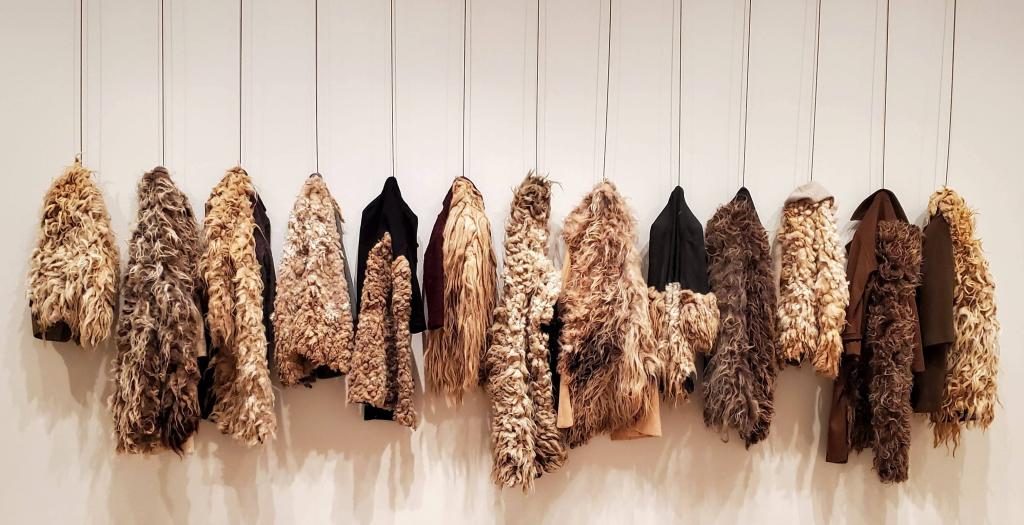
Feature image: “What’s So Lovely About the End of the World?” exhibition installation. PLACE, Portland, OR, 2023 | photo by Rhonda P. Hill

 E D G E