

A jacket and skirt ensemble have a story to tell. Did you know that the Yuyuan Garden District of Shanghai China and the American Civil War have something in common?
The common thread is Karen Glass, an artist, based in Reading (greater Philadelphia) Pennsylvania, and founder of Ø (zerøwaste) GLASS (originated in Atlanta Georgia), a platform that creates fashion with zero waste. Glass built an ensemble, Ø 2 Shanghai Jacket with Antebellum Skirt, that’s framed in a story about a torn cloth remnant from Shanghai, sewn in a reconstructed circa 1960’s vintage menswear jacket, paired with a skirt symbolic to early 1860’s pre-Civil War, where Americans grappled with the social, economic, human costs, and civil rights issues around slavery; a time also known as the end of the Antebellum Era (1812 – 1861).
Weaving a narrative of social, ecological, and cultural values, this ensemble is a juxtaposition of gender, circa, social position and culture. The look is a 1960s modern “dark” colored menswear upcycled jacket paired with an “off white” Antebellum upcycled wabi sabi (asian design aesthetic) skirt. “Live life with fewer things of greater value,” a philosophy rooted in what defines Glass and is the brand identity of Ø GLASS, reflects her deep passion for a conscious way of life.
Glass is among a select group of international designers whose work, no bias: a double entendrè and Ø 2 Shanghai Jacket with Antebellum skirt, is presented in the exhibition “CLOTH, Construct, CULTURE: fashion builds a story” … The following is a digest of the story behind Ø 2 Shanghai Jacket with Antebellum skirt, with excerpts from Ø GLASS’ statement.
A procurer of hundreds of global textiles and fashion artifacts, Glass extended the life, value, provenance, and story behind those archival pieces, a body of work influenced by the overtones of textile waste, of which Ø 2 Shanghai Jacket with Antebellum Skirt represent.
Ø 2 Shanghai Jacket
After 60 hours of reconstruction by hand, the Ø 2 Shanghai Jacket became a product of a global provenance of intricately blended textile objects, a coveted piece worthy of its collective dimension. The story began with … An embroidered cloth from a tiny shop in the Yu Garden district of Shanghai that was mounted inside a reconstructed moth-eaten 1960’s vintage menswear jacket, softly constructed and ‘modernized with a longer slimmer torso line, to reflect the trend in gender mixing and neutrality’. The brand statement continues with the eclectic origins of each contributing cloth and trim:
the taping that covers the edges of the silk chiffon panels was found in a flea market in venice italy. the cotton “mattress” thread used in the tailor stitch accents, came from a consulting project in austria for grüne erde, who’s original products included organic, handmade mattresses. the linen handkerchief in the breast pocket along with the lace attached to the sleeve bottoms came from a collection of handmade linen lace handkerchiefs that were from glass’s sister’s- (their) grandmother’s collection (youngstown oh) and her sister’s friend’s mother’s collection (berks county pa).*
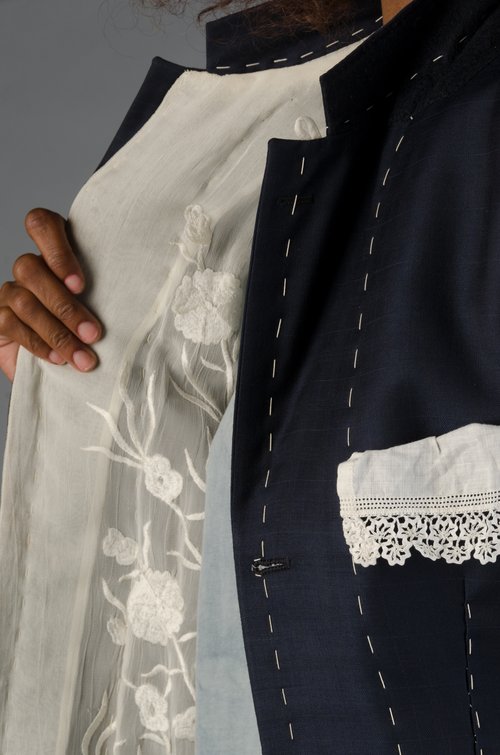
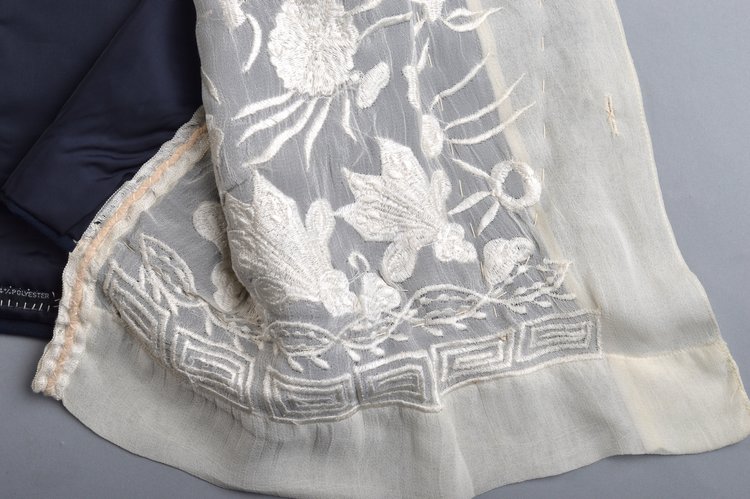
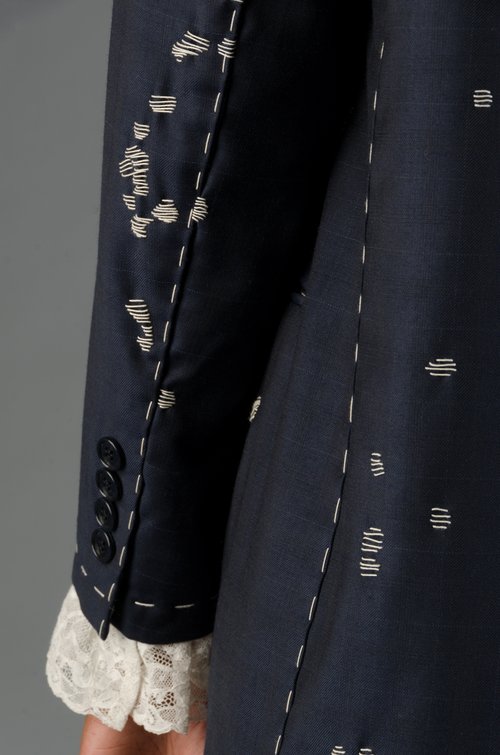
Artists go through a process of cognitive, conscious (or unconscious), philosophical, and sometimes theoretical discovery that is experimental in getting to the core of messaging. This artistic practice brings meaning, purpose, and substance to their work. The making of the jacket is one part of the story, but Glass examines a deeper message. Relating to the Chinese embroidered cloth and the jacket’s moth-eaten holes, the jacket took on a philosophical meaning as the look of the stitching repairs took shape of I Ching hexagrams as noted in Ø GLASS statement:
… most especially the solid, unbroken horizontal lines. in referring to the i ching for insight, she came to the very first hexagram (2 trigrams-top and bottom-north and south): 1. ch’ien/ the creative, denoting its dualism in character of the sublime and the great. the creative trigram carries the attributes of polarity, conservation, perseverance, prudence, justice, fortitude and temperance. this insight gave further purpose to the development of the ø work at the time and the two apparel pieces in this look really give voice to the deeper purpose glass tried to convey as a model for a fashion brand and its processes.*
Karen Glass, Ø (zerøwaste) GLASS, Ø 2 Shanghai Jacket – repaired moth-eaten holes with horizontal line motif stitching identified as the “I Ching” motif.
Photo courtesy of Karen Glass
Antebellum Skirt
The Antebellum skirt has its unique Deep South American history around the time of the Civil War. It is made out of muslin unbleached cotton. Cotton in America in the 19th century pre-Civil War is associated with African American slave labor and post-Civil War, Black laborers working in the cotton mills of the fashion industry who were either denied employment or exploited for their cheap labor. Glass uses the enslavement history of the American cotton industry and the crinoline shaped look as a paradox in economic and social power between the slaves and their owners during the pre-Civil War/end of the Antebellum period. It conveys an ‘inexpensive roughhewn, ripped, and torn’ fabric, representing the modest dress of the slaves, draped over a crinoline foundation, representing the big skirt style of dress worn by white Southern belles:
this piece was designed specifically for conceptual photography that conveyed the impressions and aspirations of the brand and its heritage city atlanta. it is constructed and deconstructed for exhibition only now. it is of multiple U.S. origin, secondary market sourced, raw, washed, cotton muslin that is supported by a 2nd hand (thrift store) wedding dress with a crinoline underpinning to capture the volume and drama of the style of the antebellum period. the haphazard, organic, untamed, suggested “falling apartness”, of the wrapped and draped skirt attempts to capture and suggest the “underpinned” state of the pre-civil war south, suggesting that antebellum culture and its economy was not sustainable. at the beginning of the civil war, two thirds of the world’s cotton was coming from the slave-labor us south. the elaboration of style capturing the era, is in contrast to the cotton muslin, inexpensive roughhewn basic fabric, ripped, torn, roughly stitched, twisted and belabored speaks further to the antebellum south’s emergent major commercial crop-cotton, grossly economized by human chattel.*

Notes, Further Reading
- *glass has not used letter case in 13 years since she committed to a zerøwaste life.
- Read more about Karen Glass, the influences of living and working in Atlanta, the studio factory at the Goat Farm Arts Center where Ø 2 Shanghai Jacket with Antebellum Skirt was created, and how America’s history of the Deep South contributed to this ensemble: no bias Ø 2 Shanghai Jacket with Antebellum Skirt full statement.
- no bias: a double entendrè artist’s installation overview (statement) – six-part canvas series
Karen Glass bio
Ø (zerøwaste) GLASS
@glass_km
Read the EDGE interview with Karen Glass: Fashion Artifacts: A Sustainable Path to Circular Fashion | EDGE Talks to Karen Glass
Exhibition Details
CLOTH, Construct, CULTURE: fashion builds a story, curated by Rhonda P. Hill, 24 October 2023–24 January 2024, Parallax Art Center, Portland, Oregon, USA
Feature image: Karen Glass, Ø (zerøwaste) GLASS “no bias Ø 2 Shanghai Jacket with Antebellum skirt”, “CLOTH Construct, CULTURE: fashion builds a story”, Parallax Art Center, Portland, Oregon, October 2023 | Photo by Rhonda P. Hill. Unless otherwise noted all photos courtesy of Karen Glass.
 E D G E