… About Connection, Dismissed, Earth, and Identity.
Kyle Denman, Isabella Diorio, Korina Emmerich (Puyallup), Karen Glass, Alena Kalana, Ruree Lee, Maital Levitan, Abiola Onabulé, and Yun Qu, in the exhibition CLOTH, Construct, CULTURE: fashion builds a story examine today’s deep-seated world issues centered on four core themes: Connection, Dismissed, Earth, and Identity, transforming profound storytelling into physical form.
Connection
Are we lost without human connection? A social and scientific debate about society’s screen-addictive habits is playing out in real time.
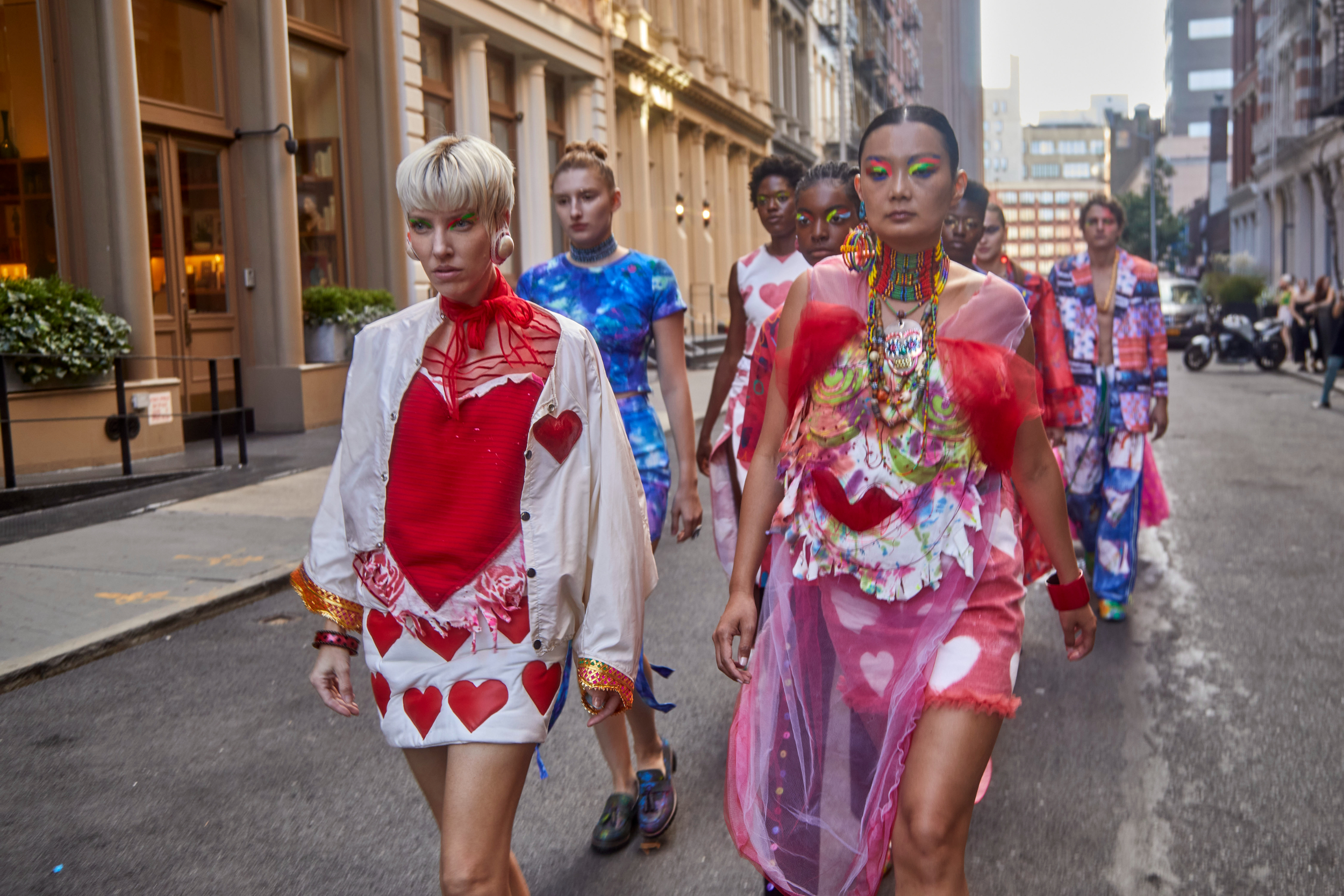
Utilizing deadstock materials to create her own textiles, Lee’s collection Presence/Absence (2018) serves as a material critique of our smartphone dependency, illustrating how digital isolation erodes human well-being.

“The dress, 003 Tie at Sleeve Midi Dress (2018), that is tied at the hands represents “touching phones”—the square print represents the screen, and the organic embroidered shape represents the fingerprints. I wanted to tie the hands so that you couldn’t use your phone! So, I would say this knot symbolizes a restriction of phone usage.” – Ruree Lee
Lee’s 002 Pleated Short Sleeve Dress (2018), made from viscose with an organza short sleeve, this look features a striking front-panel contrast detail. According to the designer, this structural shape is a clever visual commentary on modern human posture while phone texting.
Psychologist Abraham Maslow’s “hierarchy of needs” theory on humans’ need for belonging, along with other human conditions, is referenced in Denman’s “mul·ti·po·lar—ex·ist·ence” (2021), which explores the interconnectivity and the multidimensionality of the human experience. One condition is how we encounter one another and collectively share the human experience, as manifested through the hundreds of hand-cut face silhouettes on the skirt of his look, Vibration.
Vibration, Look #007, Yellow Tea-Length Dress with Tulle Face Profile, 2021
The face silhouette is featured in half of the eight looks in the “mul·ti·po·lar—ex·ist·ence” collection. Kyle Denman describes the face as an unknown and left to the interpretation by the audience. He says, “In one perspective, that face is meant to represent the human experience. In another, it is meant to represent the onlookers themselves. Whoever this may be, his, her, or their emotions are left up to interpretation. The garments feature a concept of duality and facade—one is not as it appears.”

Bold and well-conceived abstract and representation design details define the looks in Lee and Denman’s collections.
Dismissed
Marginalized and victimized people and communities sit on the fringes of society; excluded, dismissed, and dis-empowered. Diorio, Emmerich, and Onabulé reconstruct the dominant historical narrative, allowing for a more inclusive understanding of history that recognizes the agency and contributions of those who have been silenced for too long.
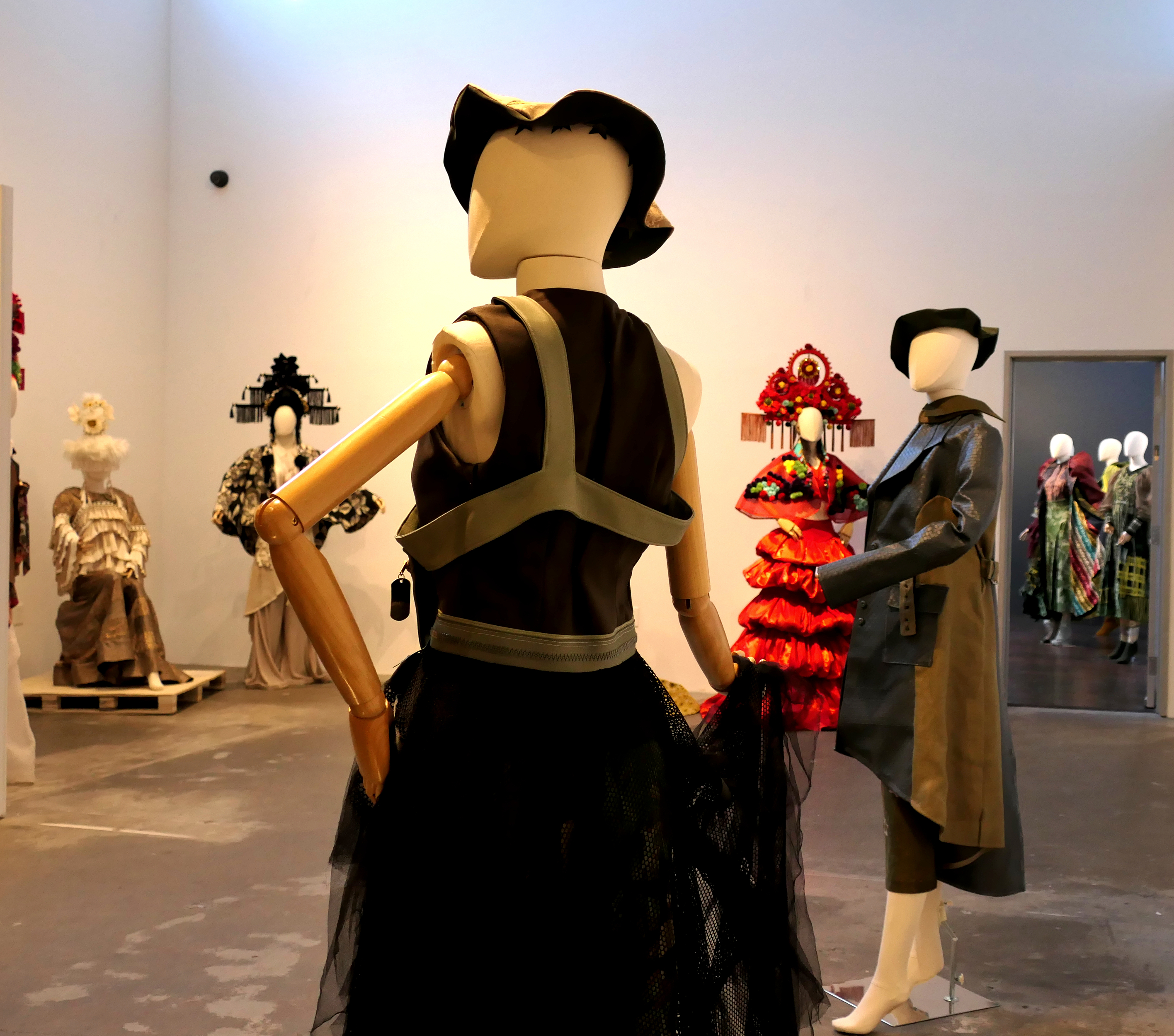
Troubled by the rising population of homeless female veterans and inspired by the courageous and bold acts of trailblazing women in the military, Diorio created the collection Female Engagement Team (F.E.T., 2020) as a tribute to these women. With nearly 2 million women veterans in the United States, F.E.T. documents the overlooked history of 12 women vets, some even going so far as to disguise themselves as men when they could not legally serve.
Skillfully created out of renewable materials, each piece in her collection bears the names of these 12 honorable women, such as The Cathay Dress, named after Private Cathay Williams, aka William Cathay (disguised as a man), who served post Civil War, was born a slave, and the first documented Black American female to serve (Buffalo Soldier). The Brewster Bolero is named after Rear Admiral Grace Brewster Murray Hopper (World War II, Korean War, Vietnam War), who is founder of the COBOL programming language, a precursor to many of the software code approaches of today. Her work is legendary among computer scientists and mathematicians.
The Johnson Jacket is named after Private Opha May Johnson (World War I), who was the first woman to enlist in the United States Marine Corps, joining the Marine Corps Reserve in 1918 during World War I. The Sarah Skirt is named after Sarah Emma Edmonds (Civil War), who was one of the few famous women veterans from the Civil War, a time when women were not allowed to serve in the military. In 1861, Sarah joined the United States Army, disguised herself as a man, and went by the name Frank Thompson. She served in the Second Volunteers of the United States Army as a male nurse and a Union spy.

(l-r) Cathy Dress, Brewster Bolero, Woodland Beret; Johnson Jacket, Sarah Skirt, Desert Beret, 2020
“I felt that the fact that these women go into a male dominated field and are able to compete with the best of them was one that was often overlooked. With this in mind I wanted to create a collection that showcased this strength and femininity, without compromising the identity of the woman herself.” – Isabella Diorio
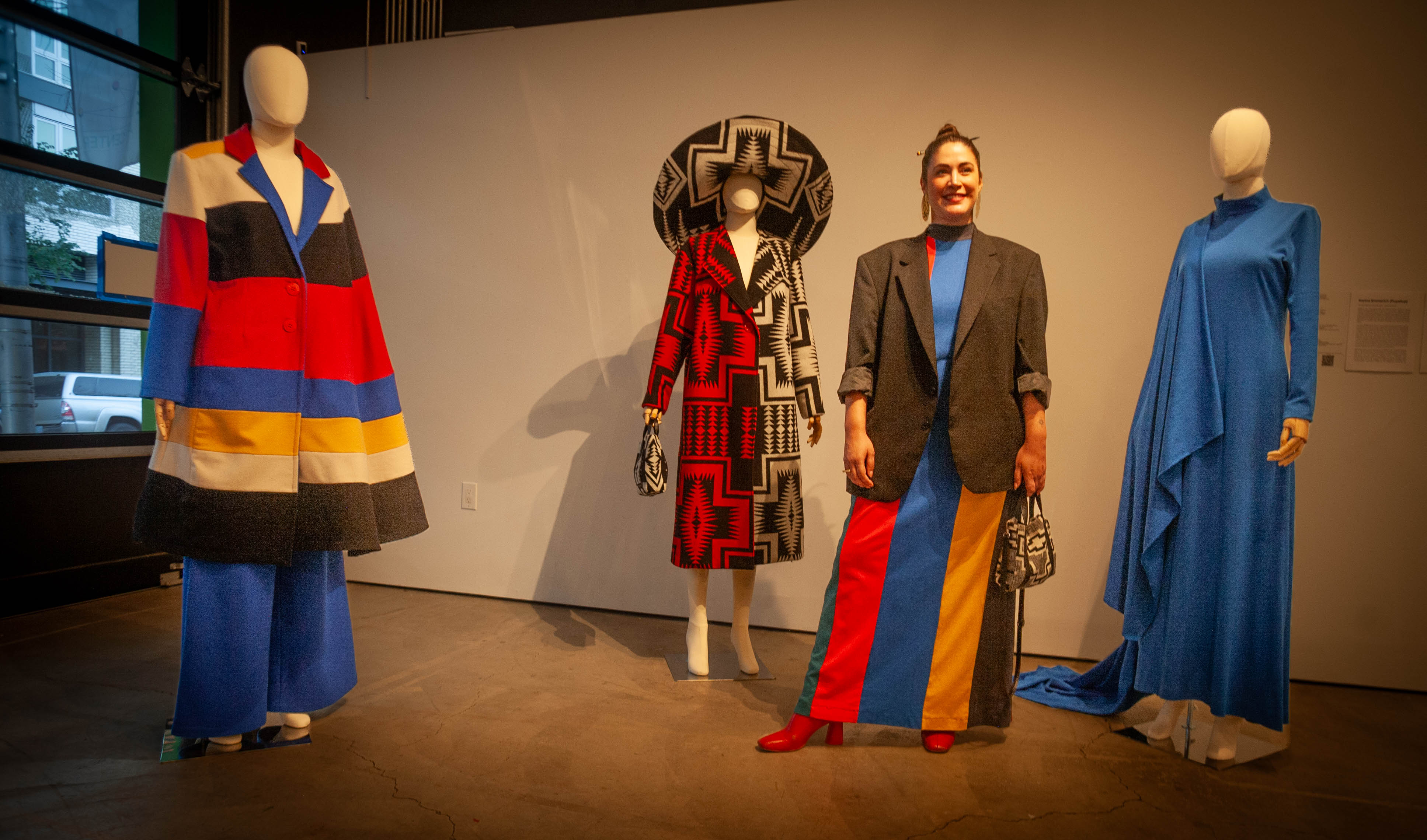
Emmerich’s ensemble Cascade (2021) is crafted from Pendleton’s recreation of a Hudson’s Bay Company (HBC) Point Blanket. By featuring this textile, Emmerich directly confronts the iconic blanket’s brutal colonialist history—a legacy closely tied to her own ancestors, who worked for the HBC in the early nineteenth century. With a colonial history spanning over 350 years, the HBC Point Blanket has been variously viewed as a Canadian icon, a critical trade item, a symbol of colonialism, and a vector of disease. Through this personal connection, the ensemble amplifies the significance of a North American history that is still being reckoned with today.
Cascade, 2021, was exhibited in In America: A Lexicon of Fashion, The Metropolitan Museum of Art, September 2021 to September 2022
“The Cascade look brings attention to the colonial violence perpetrated by the Hudson’s Bay Company,” says Emmerich. “The red button symbolizes that violence. 4th x great grandfather Anawiscum (Annawiskum) McDonald worked for the HBC stationed at Fort Langley; he was York Factory first nations (Swampy Cree) from Manitoba. He went from a canoe middleman from 1826-1840 and moved up to be a cooper until his retirement in 1842, in Cowlitz, an area my family still resides in today.” – Korina Emmerich

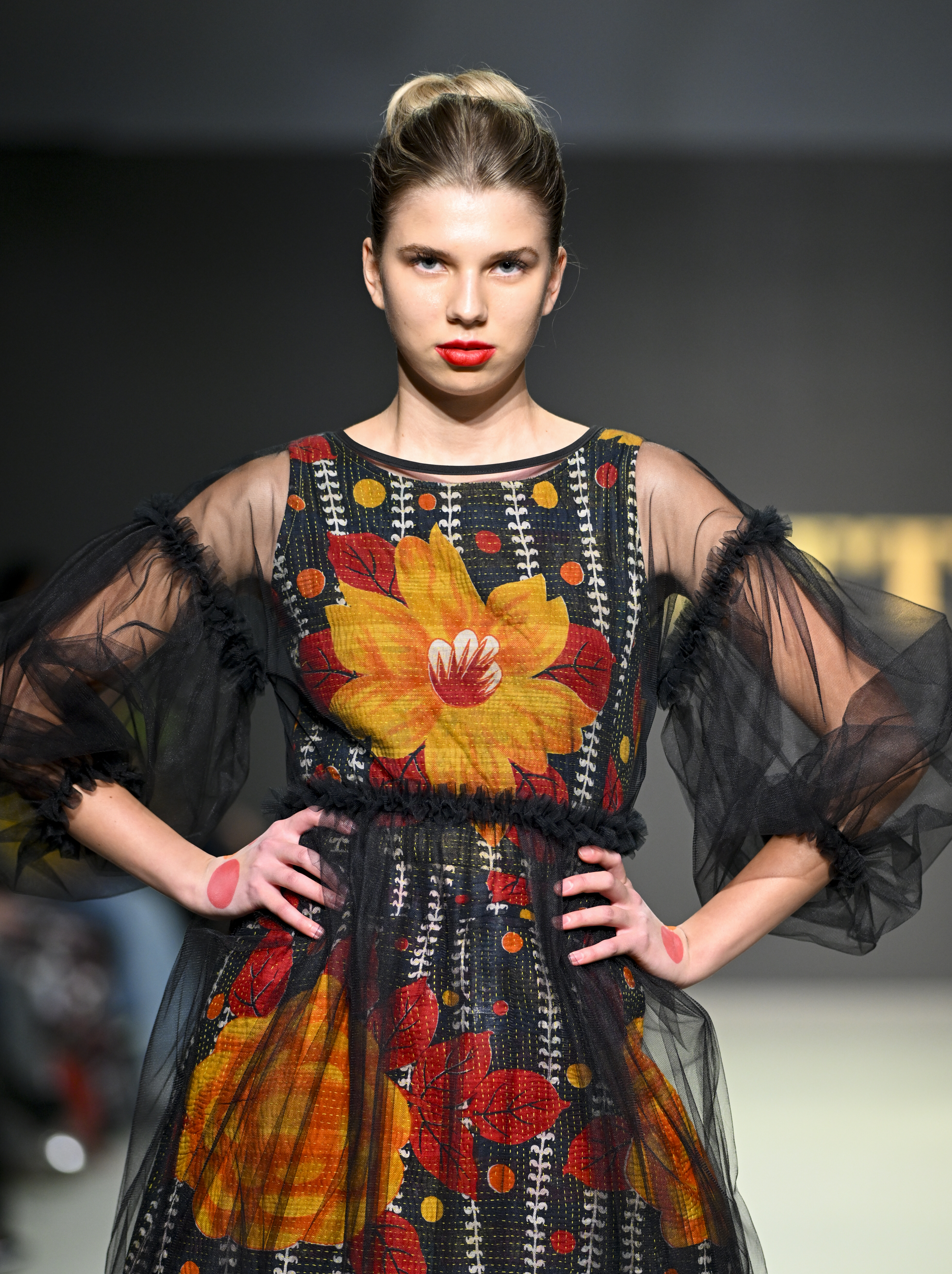
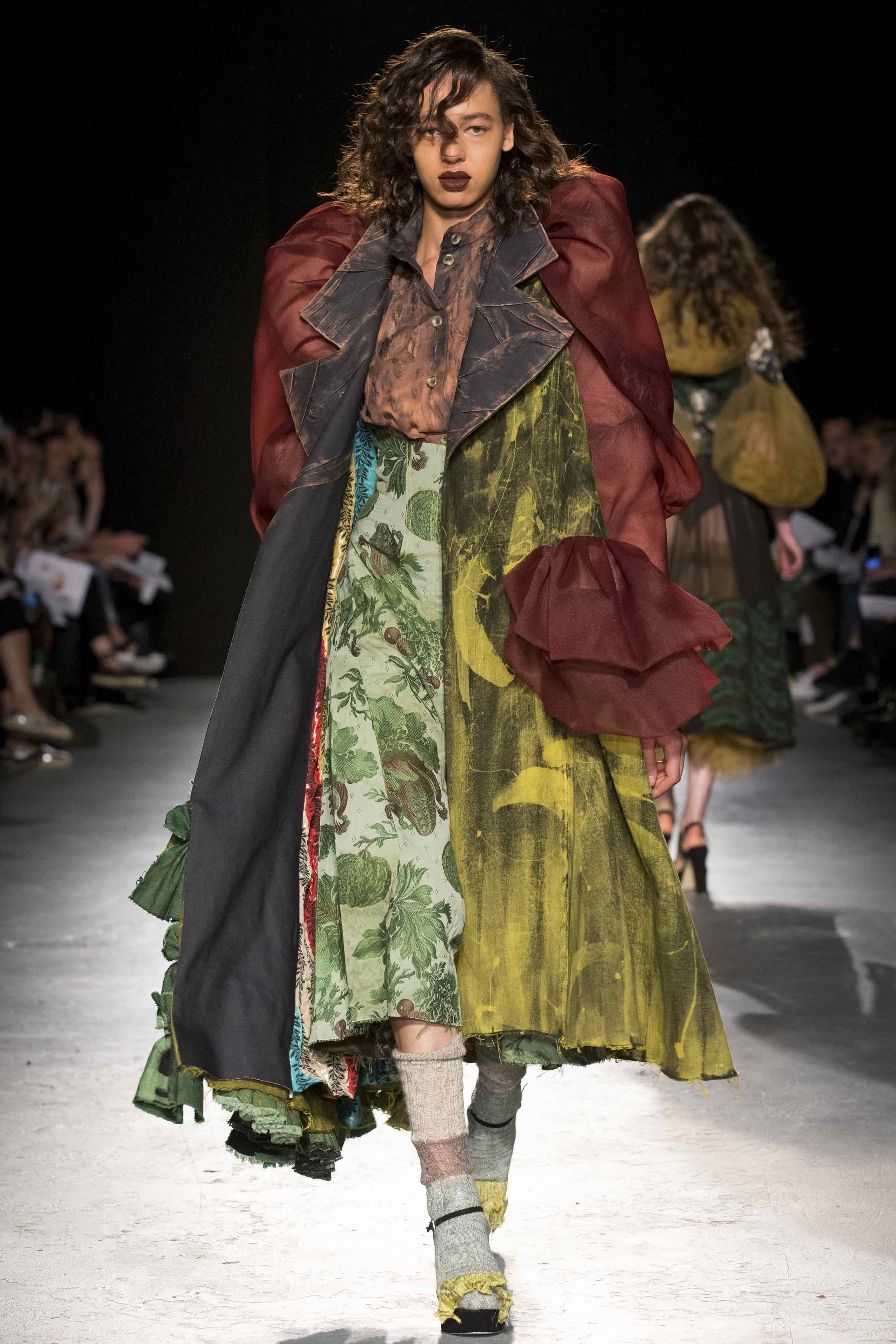
Abiola Onabulé’s work is an example of how African diaspora narratives are largely overlooked, excluded from the dominant Western narrative—historically marginalized as vital contributors to fashion. Inspired by her Nigerian matrilineal roots, Onabulé’s Heirloom (2017) reclaims the historical narratives of West African women who served as healers, priestesses, and misunderstood spiritual guardians. Cast aside, they found ways to overcome and survive through strength, creativity, and resilience. Threadbare and worn looks reference the toughness and survival of these women.

(l-r) #61 Sheer-Sleeved Jacket, Ruffled Dress; #66 Big-Shouldered Puffy Sleeve Coat, Blouse, High-Waisted Trousers, 2017
“I am … trying to understand the histories of the women who came before me, who were able to lay out the path that I am then able to continue following, particularly because those women’s narratives are often eclipsed by the paternal narratives within a family tree.” – Abiola Onabulé
Earth
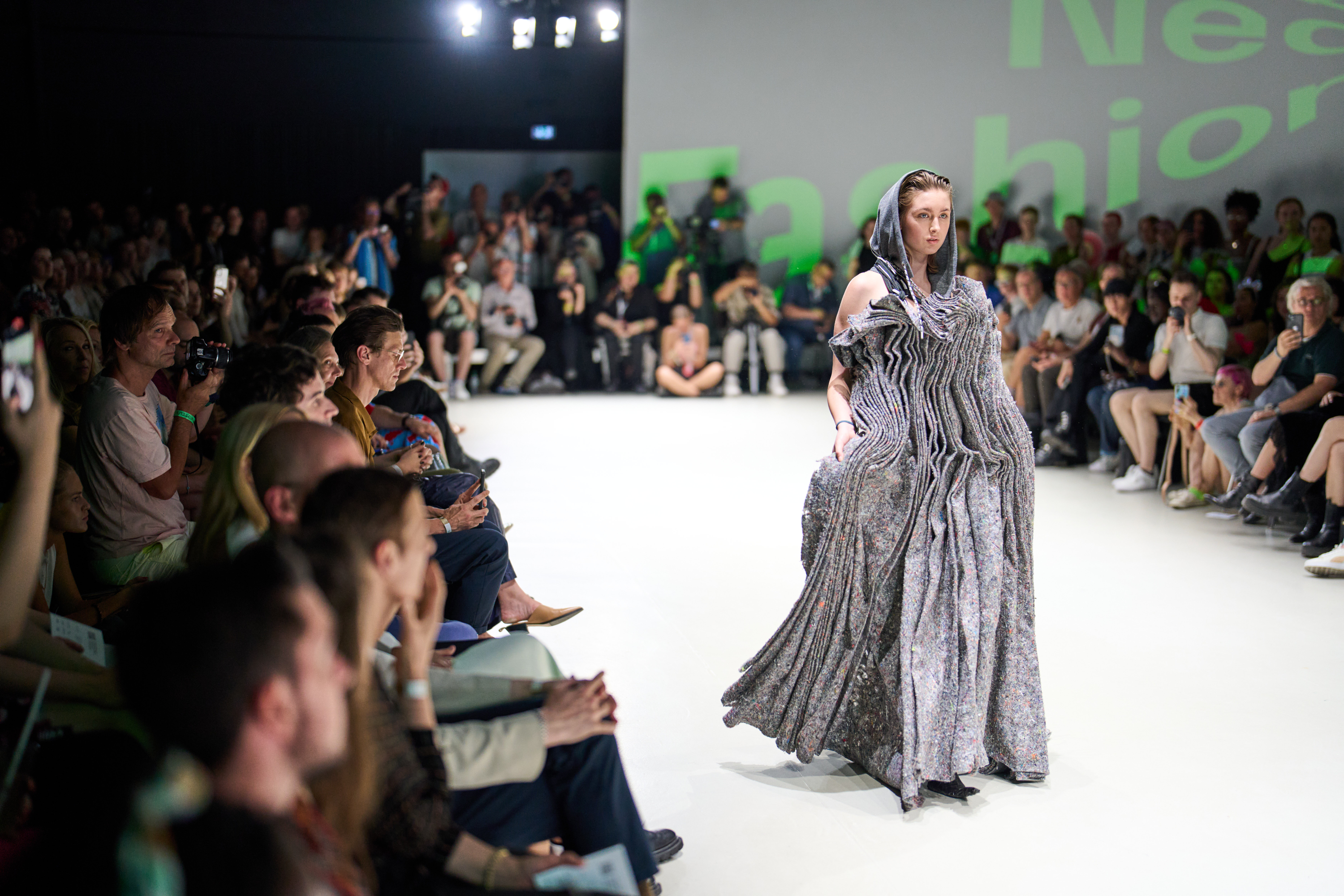
The Earth theme grounds the CLOTH exhibition in absolute authenticity. Rejecting superficial greenwashing narratives, all designers in the show embed true environmental stewardship into their practice—preservation, conservation, and regeneration are guiding principles, particularly when fashion is identified as the planet’s third largest polluter. The outcome is a striking showcase of looks crafted from natural fibers, deadstock, recycled textiles, and fabric scraps, engineered to minimize waste. A few examples from the work of Kalana, Qu, and Emmerich.
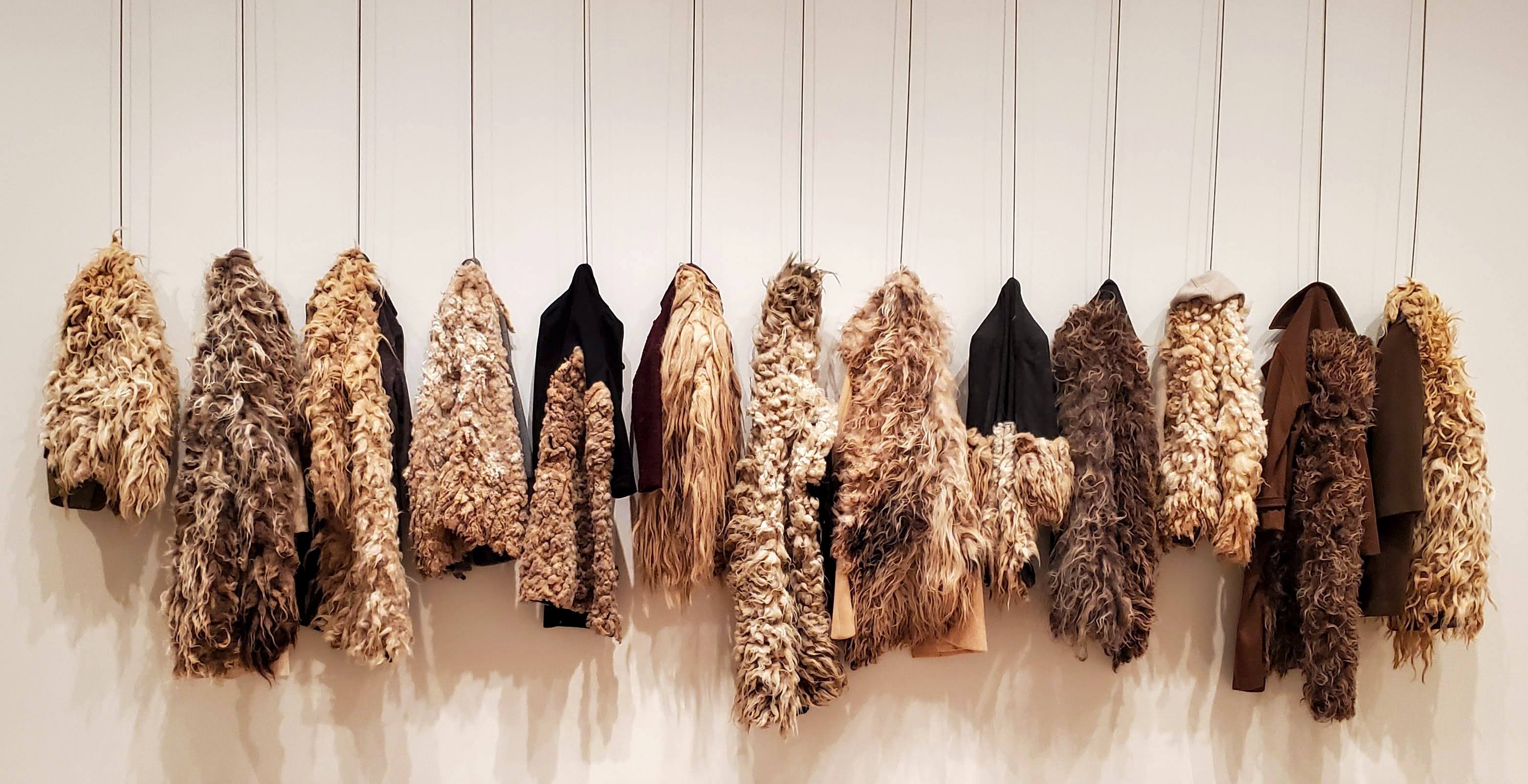
Inspired by the Tibetan culture and the nomadic ecological way of life, Kalana breathes a new life to deadstock materials, some typically used in home interiors, such as carpet grippers, richly textured upholstery, in her body of work titled, Tibetan Transplant.
Qu uses luxe biodegradable deadstock materials for her non-season-specific collection, Clair De Lune—a critical intervention against waste culture—opposing an industry that encourages seasonal collections.
Emmerich, a social and environmental justice advocate, whose work reflects her patrilineal Indigenous heritage stemming from the Pacific Northwest Coast Salish Territory, Puyallup tribe, where sustainability is central to Indigenous culture, is part of the slow fashion movement, that yields an ethical and ecological practice.
Identity
Individualism, identity, independence, gender neutrality—please, no labels! In a time marked by divisive politics, the show’s ensembles become vibrant canvases for celebrating multiculturalism, individual and cultural identity.
Glass’s no bias: a double entendrè, deconstructs identity, expressing the movement from gender juxtaposition toward gender neutrality amidst the cultural movement of eco social values in fashion.
Levitan, of mixed heritage, conveys a message of mixed identity in her body of work Culture Osmosis, believing that we are all connected and part of a global tribe, but challenged in finding our own individuality and belonging.

Why Maital Levitan’s work is not shown in the exhibition:
Culture Osmosis is a story about identity in a multicultural world created by Maital Levitan that would have been exhibited here. Maital was born in Seattle, grew up and schooled in Israel, graduating from two of the world’s most prestigious fashion school—Shenkar College of Engineering and Design in Tel Aviv and a Masters in High Fashion Haute Couture from the Academy of Costume and Fashion in Rome. Levitan currently lives near Tel Aviv. Levitan served for five years in the Israel Defense Force achieving the rank of captain before finishing her advanced studies and degrees.
Her contribution to CLOTH, Construct, CULTURE was packed up and ready to ship from Israel when Hamas terrorists brutally attacked Israel initiating a war whose rockets quickly made Israel’s roads and skies unsafe for commercial transport.
As of the mounting of this show, Maital last reported: “My family is safe for now. Difficult times. Really unbelievable. A true horror movie.”
We would like to dedicate her space in this show in memory and respect of people of all cultures and identities being able to peacefully coexist on this planet without fear and to condemn all acts of genocide and violence against innocent people.
Exhibition Details
CLOTH, Construct, CULTURE: fashion builds a story, curated by Rhonda P. Hill, 24 October 2023 to 24 January 2024, Parallax Art Center, Portland, Oregon, USA
References
- National Veterans Foundation. 2015. “Famous Women Veterans Every American Should Know.” Accessed March 2021. https://nvf.org/famous-women-veterans-american/
- Mclain, Sean. n.d. “7 Badass Women Who Made Military History.” Accessed March 2021. https://www.military.com/history/7-bad-ass-women-who-made-military-history.html
- Bella Dio. n.d. “Female Engagement Team.” Accessed March 2021. https://www.belladiodesigns.com/fet-collection
All photos: “CLOTH Construct, CULTURE: fashion builds a story”, Parallax Art Center, Portland, Oregon, October 2023. Photography by Rhonda P. Hill.