

“As I delved into biblical teachings on resurrection and judgment, I wondered: What if our commitment to sustainability became as essential as faith itself? What if it became the determining factor for one’s resurrection? Would such a paradigm shift compel everyone to reassess their priorities? Don’t we all long for a resurrection? Isn’t it akin to the desire for wasted materials to be upcycled? That is the genesis of the story.”
-Jie Chen
A bag of trash, textile scraps, and discarded clothes are the only resources that can be transformed to make fashion says designer Jie Chen, who envisions a future where choices of consumption are a matter of life and death.
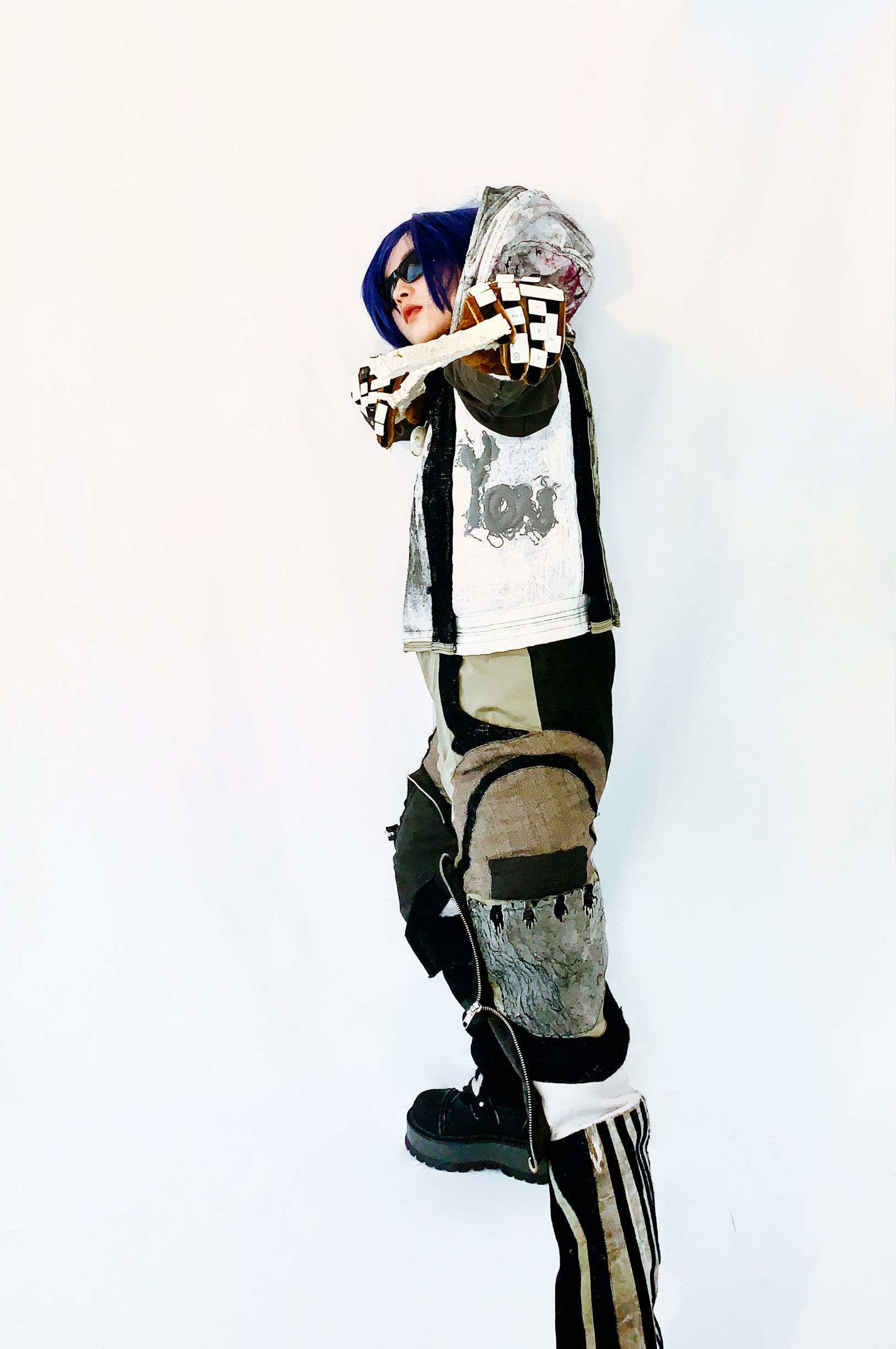
Chen’s collection “22nd REV: Grave to Cradle” is a futuristic story about textile rationing and legal ramifications if humanity continues to disregard earth’s diminishing resources. Irresponsible business practices and consumption behavior play into her story which conveys a dark warning to the fashion industry and its participation in the environmental crisis stemming from up channel (manufacturing) pollution and down channel (consumer) waste. She says, “in an audacious response to a dystopian vision of a world teetering on the brink of overproduction and over-consumption, “22nd REV: Grave to Cradle” embarks on a transformative journey … and those found guilty … face a hauntingly inescapable fate.”
Although our talk is about hope, optimism, and perspective around the transformative re-birth of textile trash, I had to ask what inspired her to set the tone for such a story. She reveals, “I’ve always been drawn to black humor and Magic Realism, so I infused these elements into the story to underscore the absurdity of our world, which is no less surreal than my darkest visions of the future.”

BFA Fashion Design graduate of Parsons School of Design and currently based in New York City, Chen hails from Wenzhou, China, a port and industrial city in China’s Zhejiang province. Her formative years were spent in the northeast region of China, near the Russian border, and at the age of fifteen she moved to Canada to explore her artistic aspirations.
Chen’s journey from childhood to the creation of “22nd REV: Grave to Cradle”, created in 2022 at Parsons, and the influences along the way have shaped who she is and why this collection matters. Our talk highlights four themes: 1) how fashion helped her with her own identity; 2) being exposed to her birth city’s polluted surroundings – constant grey film in the air and toxic odor from plastic packaging factories – inspired her sustainable path and the collection’s self packaging concept; 3) at Parsons, witnessing waste from scraps on the floor, trashed and abandoned art and fashion projects was a compelling factor to re-purpose her peers discarded materials; and 4) her insights into the future of fashion present a dual responsibility as consumer and industry professional.

I. Fashion’s Role in Self-Discovery
I found fashion could be a medium that allowed me to peel back layers of self-doubt and delve into a realm of self-discovery. It was through the creative process of styling and experimenting with clothing that I began to unearth parts of myself I had never acknowledged before.
– Jie Chen
Rhonda P. Hill. While growing up in China and Canada, your interest in fashion came from several aspects and influences, along with uncertainty about your identity and true passion for the arts. What was that like?
Jie Chen. My earliest fashion inspirations stem from the Japanese anime ‘Cardcaptor Sakura,’ where the protagonist’s combat costumes, crafted by her best friend, ignited my fascination with drawing comic girls adorned in dresses, sprinkled with my early design flair. This marked the inception of my subconscious appreciation for beauty and fashion. However, as I progressed through school, academic studies consumed much of my time, and the mandatory school uniform became my daily attire, momentarily diverting my attention from fashion. Yet, the passion remained deeply ingrained within me, albeit hidden. At times, I felt hesitant to openly express my interest in fashion, fearing it would be perceived as a distraction from my academic responsibilities. During those hectic academic years in China, I grappled with uncertainty about my identity and struggled to discern my true passions amidst the rigors of study. After I decided to pursue my artistic path in Canada, I was still uncertain about the specific direction within the realm of art I would take in college. However, it was during this period that my long-standing fascination with fashion blossomed into a fervent desire to explore it further.
RPH. Fashion is a powerful means to transform identity. What was that exploration like for you in discovering your identity?
JC. Given the freedom to curate my own wardrobe and experiment with personal style, I found fashion could be a medium that allowed me to peel back layers of self-doubt and delve into a realm of self-discovery. It was through the creative process of styling and experimenting with clothing that I began to unearth parts of myself I had never acknowledged before. Fashion, therefore, became not only a means of outward expression but also an inward journey of exploration and understanding. It provided me with the freedom to discover who I truly was and who I aspired to be. This newfound passion solidified my resolve to study fashion in college. To assess my compatibility with this field, I enrolled in a summer program at Parsons during grade 11. It was there that I gained hands-on experience with sewing machines and crafted my very first garment. Witnessing my sketch come to life filled me with a profound sense of achievement, reinforcing my commitment to pursuing fashion education at Parsons.
II. Concept. Why Fashion Matters as a Means of Storytelling
Reflecting on why many of us remain indifferent to environmental issues, despite their looming threat, I pondered what it would take for sustainability to become a matter of life and death. This train of thought led me to consider the parallels between environmental stewardship and religious faith.
-Jie Chen
RPH. I love how you see ‘fashion as a carrier to tell stories’. I do too. As a storyteller, what inspired you to set the tone of this collection as a futuristic story expressed so eloquently in your statement:
In an audacious response to a dystopian vision of a world teetering on the brink of overproduction and overconsumption, “22nd REV: Grave to Cradle” embarks on a transformative journey. This collection confronts the stark realities of a future where the Earth is inundated with a burgeoning population and dwindling resources. Here, a radical global law assesses individuals’ sustainable credits, serving as the ultimate arbiter of life and death. Those found guilty of overconsumption face a hauntingly inescapable fate.
JC. As I mentioned in my background, I hail from an industrial city in China, renowned as one of the global hubs for manufacturing goods. The neighborhood where I resided was enveloped by several small plastic packaging factories, resulting in a perpetually gray atmosphere tainted with the acrid scent of plastic. Though I didn’t reside there for long, each return visit evoked a somber reflection on the necessity of excessive packaging and consumer goods. During the pandemic, amidst online schooling, I spent an entire calendar year in my hometown for the first time in over a decade. This prolonged stay fostered a deeper connection to the city of my birth and heightened my concern for the environmental issues plaguing my homeland.
As I returned to campus for my junior year at Parsons, I embarked on this project titled ’22nd REV: Grave to Cradle,’ where I articulated my darkest visions as a warning. I’ve always been drawn to black humor and Magic Realism, so I infused these elements into the story to underscore the absurdity of our world, which is no less surreal than my darkest visions of the future. While all the settings are rooted in reality, they are exaggerated to their utmost capacity. Reflecting on why many of us remain indifferent to environmental issues, despite their looming threat, I pondered what it would take for sustainability to become a matter of life and death. This train of thought led me to consider the parallels between environmental stewardship and religious faith. As I delved into biblical teachings on resurrection and judgment, I wondered: What if our commitment to sustainability became as essential as faith itself? What if it became the determining factor for one’s resurrection? Would such a paradigm shift compel everyone to reassess their priorities? Don’t we all long for a resurrection? Isn’t it akin to the desire for wasted materials to be upcycled? That is the genesis of the story.

III. The Making Of ‘Grave to Cradle’
RPH. Where did you source your trash, the discarded materials, and scraps from? I particularly like your choice of form: eye-popping aesthetics, with function and practicality. Is there a deeper message embedded in your design, beyond the obvious composition of each look from unwanted materials?
JC. When I began this project, I knew I would be using recycled materials, but I wasn’t initially sure where to find materials for upcycling. However, I soon discovered everything I needed in the recycling bin and the trimmed-off scraps, even fibers scattered across the classroom floors at school. Despite the creative journey of my art education, a sense of guilt often shadows me. I wrestle with the realization that our student projects, though experimental, often end up as discarded art pieces that consume significant resources without offering functional value. Witnessing fine fabrics abandoned as scraps on the floor only deepened this guilt, compelling me to alleviate it by repurposing my peers’ discarded materials.
RPH. Did you examine the use of biomaterials?
JC. Yes, in addition to collecting ‘trash,’ I ventured into experimenting with biomaterials, particularly mycelium. Harnessing the natural growth capabilities of mycelium, I cultivated it within a mold to create the skull pendant, which I then used as the zipper pull and the swords in my photoshoot.
By strategically sourcing materials, I aimed to seamlessly blend the concept into the making process, minimizing waste and reshaping the narrative from ‘art to trash’ to ‘trash to art’. This approach embodies the essence of my collection’s title, ‘grave to cradle’, symbolizing the journey of repurposing discarded materials into meaningful creations.


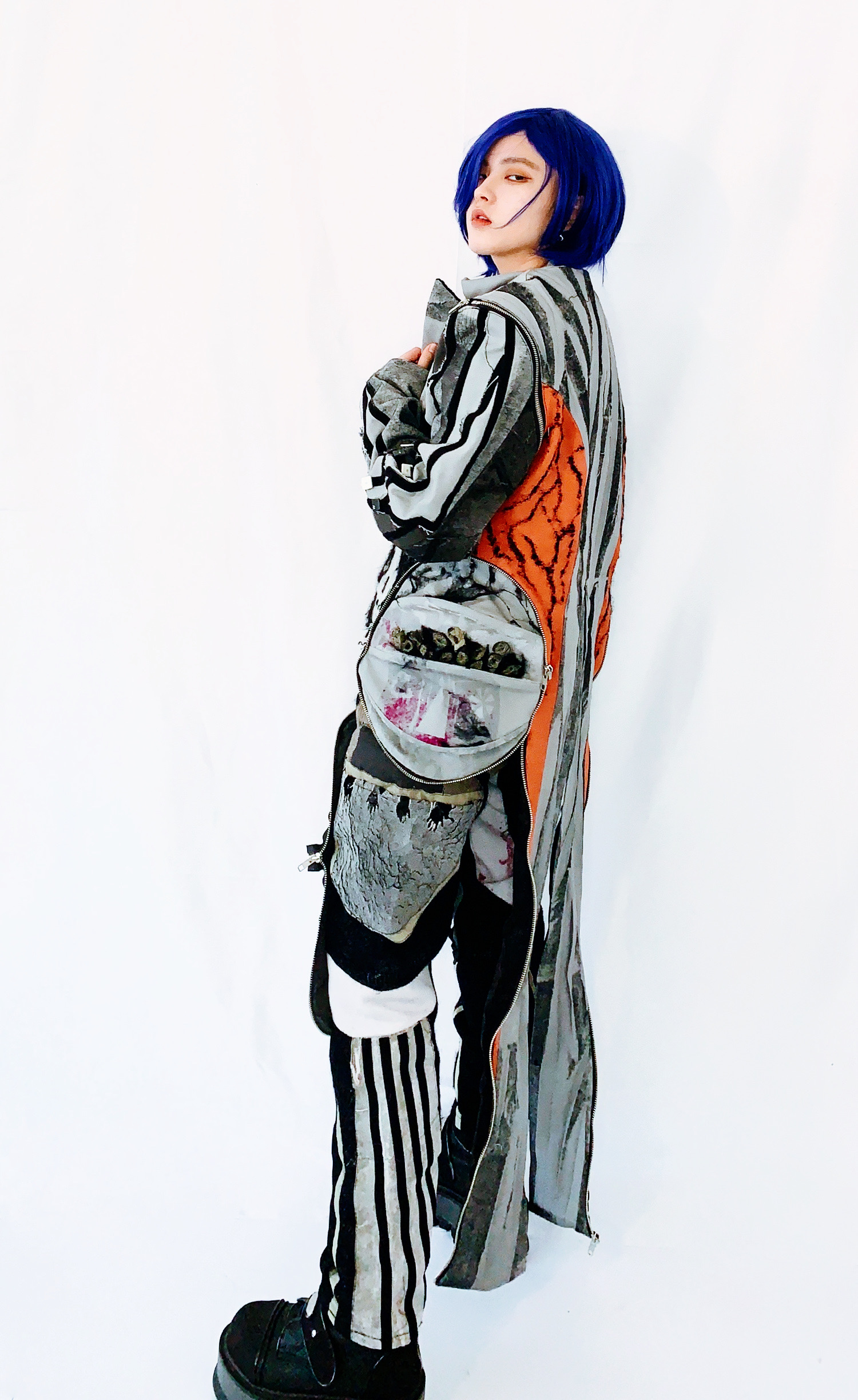
RPH. Another part of your story is that the garment has another function. It can morph into a bag when not worn. What was your thought in developing this part of the look both conceptually and structurally?
JC. I aimed to infuse my visual designs with imaginative imagery, drawing inspiration from unexpected sources. For instance, I integrated the structural elements of baby stroller caps—symbolic of birth—into garment hoods, merging functionality with aesthetics. Additionally, motifs like skulls and spooky elements in my textile designs resonate with themes of mortality and the consequences of unsustainable living. With a personal aesthetic leaning towards retro-futurism and a warrior aesthetic, I explored intricate garment details, prioritizing both functionality and visual impact. Introducing detachable features not only enhances garment versatility but also addresses the issue of overconsumption and the tendency for similar styles to be purchased multiple times. Reflecting on my upbringing near packaging factories, where excess packaging contributes to environmental degradation, I reimagined fashion packaging. By integrating ‘packaging patterns’ into garments through real packaging design techniques, I aimed to create clothing that could self-package, minimizing waste and promoting easy storage. This approach resonates deeply with my vision of my own neighborhood filled with clean air.
RPH. Bravo! What an amazing packaging concept and creative, well-engineered output. It eliminates the shopping bag.
IV. The Future of Fashion – A Dual Responsibility
To preserve the purity of fashion and continue deriving joy from it, we must treat it as a cultural relic.
– Jie Chen
RPH. Your story is not too far-fetched. It is the future. Your work taps into the zeitgeist of today. We are in an urgent crisis driven by waste, excess, and insensitivity to the preservation of Earth’s resources. Your work also conveys an artistic and experimental expression, one that the industry does not embrace. Given all of that, what do you think of the fashion industry today and how do you view fashion’s role in today’s sociocultural space?
JC. I find myself in a constant state of balancing my enthusiasm for creating innovative designs with the worry that they may end up as waste, squandering valuable materials. While I may feel powerless as an individual to enact sweeping changes to the status quo, I recognize that I can always make changes within myself. Despite acknowledging that fashion is a significant contributor to today’s environmental issues, I cannot deny its importance in helping me explore my identity. To preserve the purity of fashion and continue deriving joy from it, we must treat it as a cultural relic. What if overconsumption leads to a day when fashion becomes a luxury, even taboo? It’s not fashion itself that’s to blame, but rather the industry, its stakeholders, and consumers who collectively shoulder responsibility for the current environmental crisis. While I once only played the role of consumer, I now find myself part of the industry. This duality reminds me of my double responsibility to shield fashion from criticism and ensure we can continue to enjoy its benefits. Whether it’s through thrifting as consumers or upcycling materials and reducing packaging as designers and retailers, even small actions can make a difference.
RPH. Well said, and Jie, I’d like to end with a quote from your written statement about this work:
“22nd REV: Grave to Cradle” is not just a fashion collection; it is a manifesto for the future. I set it as a stark reminder that we hold the power to reshape our destiny by reimagining the potential of discarded materials, and by infusing innovation and purpose into every thread. In a world grappling with its own excesses, this collection is a beacon of hope, a testament to human creativity, and a powerful statement on the boundless possibilities of sustainable fashion.
Thank you, Jie Chen, for the interview, and congratulations on your mastery of storytelling and sustainable design!
Photography: courtesy of Jie Chen
 E D G E