
Change is a constant and with change comes change agents, the pathfinders, those who we name as the ‘first’. Fashion is known for its firsts.
Black fashion creators, influencers, and barrier breaking events have been largely overlooked and historically marginalized as vital contributors to the history of fashion. They have been excluded from the dominant Western narrative that encompasses art, culture, and academic institutions. However, with a paradigm shift underway to rectify this oversight; the influence of the Black global community on fashion is increasingly gaining recognition and significance.
We explore these celebrated ‘firsts’, including trailblazers like couturiers Ann Cole Lowe, Hylan Booker, and Jay Jaxon, alongside transformative milestones such as the debut of Black mannequins in department stores, the establishment of The National Association of Fashion and Accessory Designers, and the groundbreaking event that revolutionized global fashion, The Battle of Versailles. This study not only reinforces the insights gained from A Study of Eight, The Untold American Story but also uncovers significant new contributions, some of which may come as a surprise, like the activist and dressmaker Rosa Parks.
While it presents a comprehensive view, it does not encompass the entirety of the rich history of vital contributors and events. Many of us in this realm are piecing together these narratives, which are offered in the section “Sources, Suggested Further Reading”. Fashion’s Firsts: BLACK Fashion MAKERS, Influencers, and Groundbreaking Events That Shaped FASHION History is structured into five sections: “Fashion Designers at the Forefront”, “Fashion Designers, The Vanguard”, “First Black Fashion Photographer”, “First Black Supermodels”, and “Blacks Break Barriers”.
I. Fashion Designers at the Forefront
Elizabeth Hobbs Keckley [1818-1907] is best known as First Lady Mary Lincoln’s dressmaker and confidant. Keckley made 16-17 gowns the first Spring that she was working for Lincoln. The dress that Keckley designed for Mary Todd Lincoln to wear at her husband’s second inauguration ceremony and reception is held by the Smithsonian’s American History Museum. She also wrote and published an autobiography, Behind the Scenes: Or, Thirty Years a Slave and Four Years in the White House (1868).
Fannie Criss Payne [1866 -1942] was considered Richmond, Virginia’s premier dressmaker of the early 20th century. In January 1904, the Black-run magazine The Voice of the Negro, profiled Payne, noting: “The finest dressmaker in Richmond, regardless of color, is Mrs. Fannie Criss Payne. Her list of patrons is made up of the best white families in Richmond. So great is their confidence in her ability and taste that many leave to her the selection of their entire outfits. In the last six months she has made the trousseaus for the most popular brides.” Elizabeth Way, historian and curator for The Museum of the Fashion Institute of Technology, speaks highly of her work, “it was the best quality clothing that these women could get anywhere outside of Paris. She was really a skilled couturiere.” Criss Payne eventually moved to New York, as many Blacks migrated from the South due to color barriers. There she built a thriving practice designing for wealthy Black women, Broadway stars, and movie actresses like Gloria Swanson.
Ann Cole Lowe‘s [1898-1981] lifetime achievement and what she is famously known for is designing the wedding party dresses and the wedding gown worn by Jacqueline Bouvier, the future First Lady of the United States, for her marriage to John F. Kennedy in 1953, for which she did not receive credit at the time.

The most photographed and iconic wedding dress in American history. The wedding dress cost $500. The story told by her niece, Dr. Lenore Cole Alexander, from Rosemary Reed Miller’s book, Threads: The Fabric of Time, is when Lowe arrived at the front door of the Bouvier estate, she was told to go around to the tradesmen’s entrance. Lowe’s remarks, “if I have to enter by the back door, the bride and bridesmaids will not be dressed for the wedding.” She was admitted through the front door.
Designed by Anne Cole Lowe | Photo of Jacqueline Kennedy in her wedding gown in the December 1966 issue of Ebony Magazine
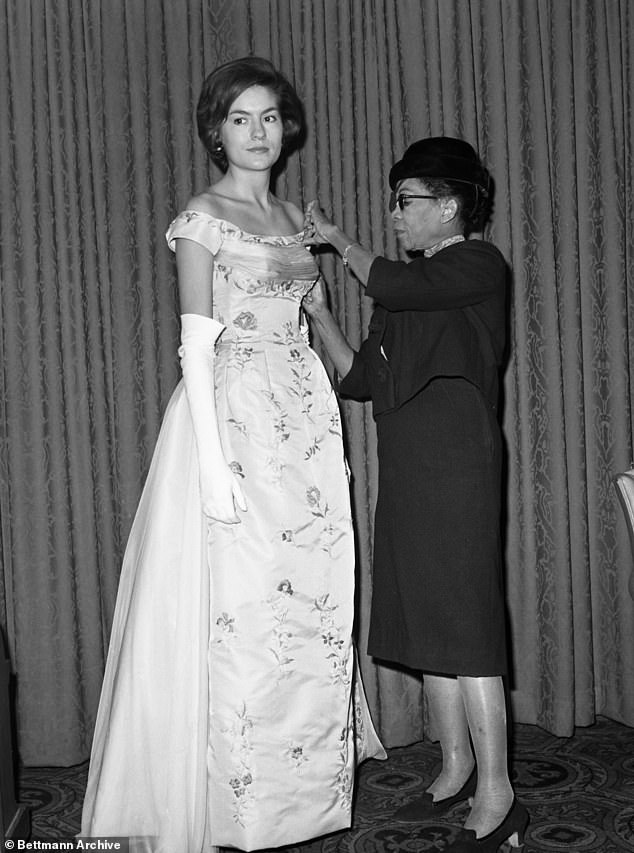
Anne Lowe fitting one of her designs on model Alice Baker at a fashion show, December 1962. With her experience and specialty in making debutante gowns and wedding dresses, she took the artisan dressmaking skills of the nineteenth century and combined it with a more modern idea of fashion design. She labeled her clothing with her own name as we see designers do today and got national press with Ebony magazine and the Saturday Evening Post.
Zelda Barbour Wynn Valdes [1901-2001] was both a fashion and costume designer. In 1948, Valdes was the first Black designer to open her own shop, “Zelda Wynn”, and claims being the first Black-owned business on Broadway in New York City. Her designs have been worn by famous entertainers such as Dorothy Dandridge, Joyce Bryant, Marian Anderson, Josephine Baker, Ella Fitzgerald, Mae West, Ruby Dee, Eartha Kitt, and Sarah Vaughan, among others. In 1958 Playboy Magazine founder Hugh Hefner commissioned Valdes to design the first Playboy Bunny costumes which made its formal debut at the opening of the first Playboy Club in Chicago, Illinois on the evening of February 29, 1960.
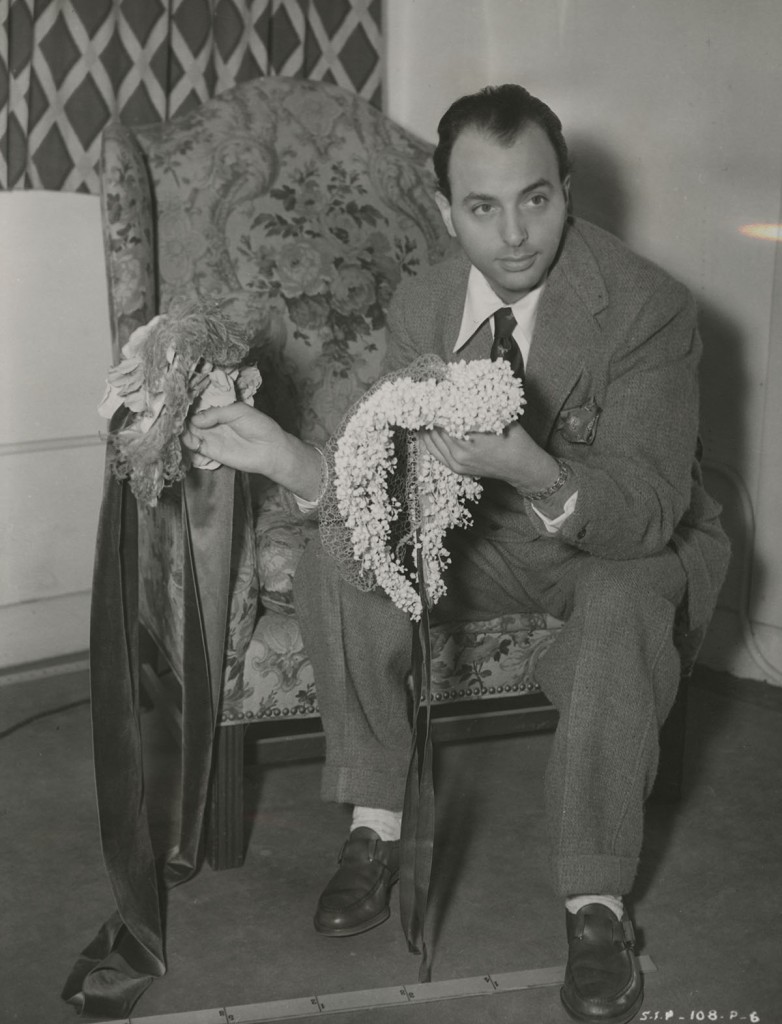
Mildred Blount [1907-1974], milliner, is famously recognized for her costume work for major film studios, in particular, the iconic film Gone With the Wind (1939), although she was not credited for her work. She is also noted for an impressive list of famous clientele, including Marian Anderson, Joan Crawford, Marlene Dietrich, and Gloria Vanderbilt. Her talent took notice when she exhibited 87 miniature hats from the period 1680 to 1937, at the 1939 New York World’s Fair, which has defined the core of her legacy. Blount became the first African American member of the Motion Pictures Costumers Union. Her hats are in the collections of California African American Museum and Los Angeles County Museum of Art.
Other Notable Dressmakers
Numerous enslaved and free women significantly contributed to the evolution of the American fashion system. While they earned their livelihoods through dressmaking, Rosa Parks [1913-2005], Harriet Jacobs [1813-1897], Margaret Mahammitt Hagan [1826-1914], and Eliza Ann Gardner [1831-1922], who was a cousin of W.E.B. Du Bois, were also abolitionists and early Civil Rights activists, while some pursued other professional interests.
Rosa Parks
Rosa Parks is renowned for her arrest on a Montgomery, Alabama bus in 1955, where she refused to give up her seat to a white man. This significant act of civil disobedience during the oppressive Jim Crow era spurred the Montgomery Bus Boycott, a transformative movement that profoundly impacted the trajectory of American Civil Rights.
… I did not spend a lot of time planning what to wear, but I remember very clearly that I wore a straight, long-sleeved black dress with a white collar and cuffs, a small black velvet hat with pearls across the top, and a charcoal-gray coat. I carried a black purse and wore white gloves. I was not especially nervous. I knew what I had to do.
– Rosa Parks reflects on what she wore to the courthouse for her trial after her arrest, written in her memoir “Rosa Parks: My Story” by Rosa Parks with Jim Haskins (1992).
A momentous occasion and her recollection of what she wore after 36 years symbolizes how the power of fashion can communicate the character of a person and representation of a community (in this example of Jim Crow South, it was necessary), while commanding respect and dignity. Yes, she ‘knew what to do’. Park’s courtroom dress was a way to assert her high value in this public arena.
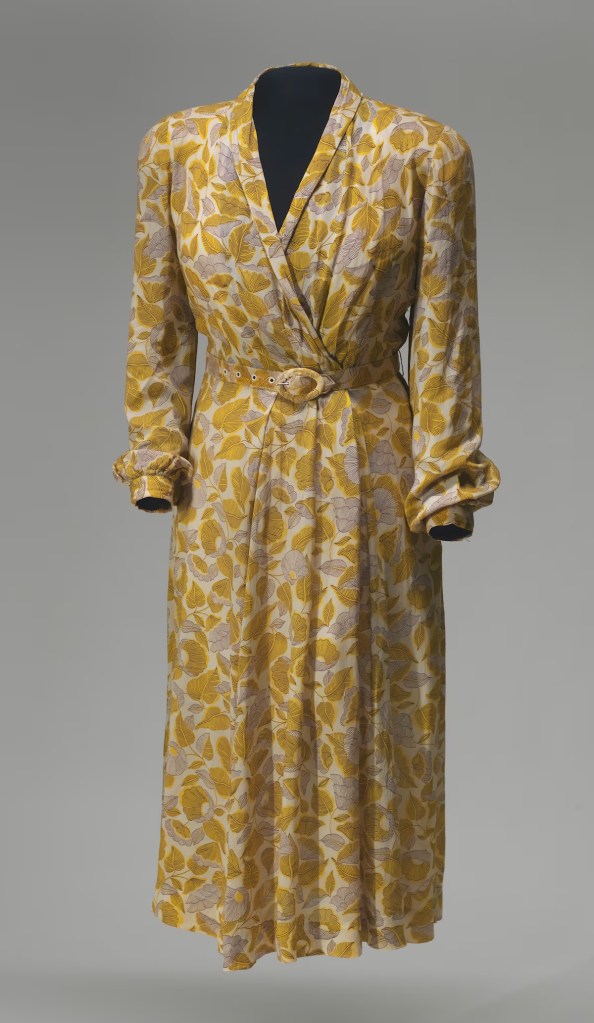
Wrap-style dress (reported to have been in her carryall bag when arrested), made by Rosa Parks, is an example of her dressmaking skills. She worked as a dressmaker at Montgomery Fair Department Store while serving the position of secretary for the Montgomery, Alabama National Association for the Advancement of Colored People (NAACP).
Photo: Collection of the Smithsonian National Museum of African American History and Culture, Gift of the Black Fashion Museum founded by Lois K. Alexander-Lane.
II. Fashion Designers, The Vanguard
Scott Barrie [1946-1993], was among a dynamic peer group of emerging Black designers, Stephen Burrows, Jeffrey Banks, Alvin Bell, Jon Haggins, and Willi Smith, who were able to build on the foundational work of Black fashion makers of previous decades, such as Ann Lowe and Zelda Wynn, and become known names on Seventh Avenue. Inspired by the couturier Madame Grès, his popular designs, primarily made with Jasco matte jersey, helped to create the look of 1970s New York. His brand Barrie Sport Ltd retailed at prominent stores such as Bergdorf Goodman, Henri Bendel, Barneys, Bonwit Teller, and Saks Fifth Avenue.
Stephen Burrows [born 1943] was the first Black designer to receive a Coty American Fashion Critics’ Award in 1973. The brilliant colors, signature lettuce-leaf hem, and uninhibited body-conscious designs of Stephen Burrows stunned the French at the Battle of Versailles Fashion Show, 1973, hosted by France’s Palace of Versailles. It was the first time American designers (Burrows, the only Black designer out of five American designers) were invited by the Chambre Syndicale de la Haute Couture, the governing body for the French fashion industry, and his career was forever immortalized in fashion history by this invitation—he was the most talked-about designer.
What was the greatest thing for me, besides my walk? Mr. Yves Saint Laurent said that Stephen Burrows was the only American designer, and that meant everything to me,
– Bethann Hardison, fashion model, advocate
Hylan Booker [born 1938] became the first Black couturier in Europe. In 1968, Detroit-born Booker was named head designer of the famed “first” couturier, Charles Fredrick Worth, the House of Worth, founded in London in 1857. In the previous year, he had won the much sought-after Yardley Award as the leading British Designer of 1967.
Jay Jaxon [1941-2006] was one of the first African Americans to work in a high-profile position in the Parisian fashion industry. He served as artistic director for the couture house Jean-Louis Scherrer from 1969-70.
Patrick Kelly [1954–1990] was an influential African-American fashion designer who achieved remarkable fame in France, becoming the first American and first person of color to gain admission to the Chambre Syndicale du Prêt-à-Porter des Couturiers et des Créateurs de Mode, the esteemed governing body of French fashion.
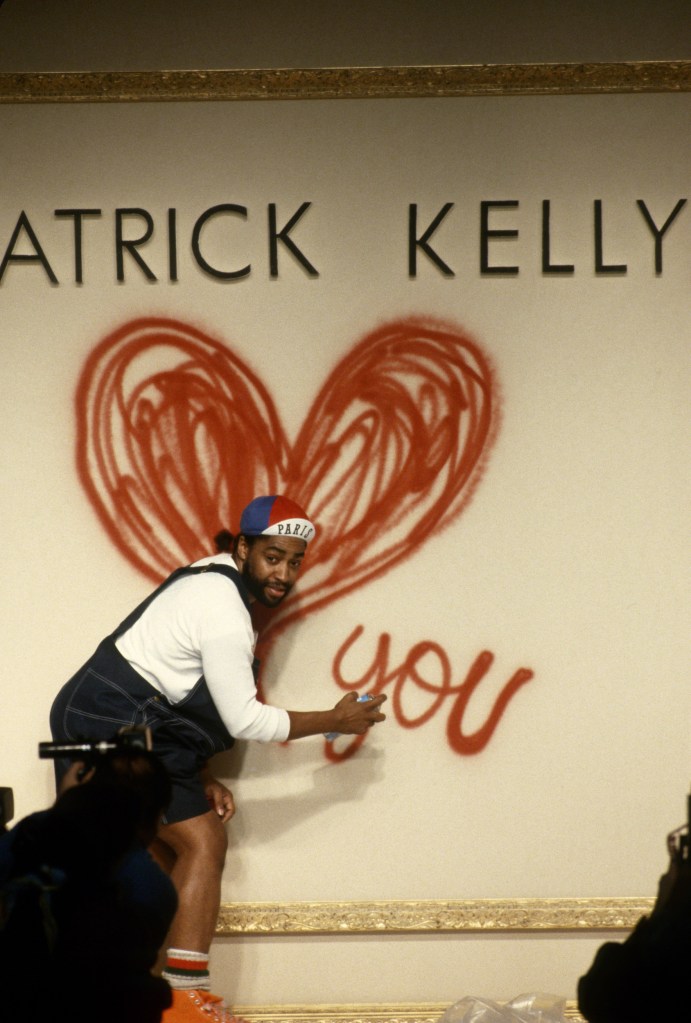
Patrick Kelly’s work marked a time in history where the French accepted the beauty and meaning of his work while Americans couldn’t get beyond his use of racist imagery. Kelly had a unique ability to reclaim, re-appropriate white society’s racist imagery, used to degrade and oppress Black people, into a beautiful body of work, his legacy, that has been a transformative experiment for the American culture.
Patrick Kelly. Getty Images, courtesy of Fine Arts Museums of San Francisco
I quit [FIT] because they told me, ‘There are no jobs for a Black designer’.
-Arthur McGee
Arthur McGee [1933-2019], in 1957, broke new ground as the first known Black designer to run a design studio of an established Seventh Avenue apparel company, Bobbie Brooks. Inspired by his mother, who was a dressmaker and lover of hats, he studied apparel design and millinery at the Fashion Institute of Technology. While there, he worked for the American couturier Charles James. Frustrated by the industry’s pervasive barriers, he chose to leave FIT, asserting, “I quit [FIT] because they told me, ‘There are no jobs for a Black designer.” Undeterred by these obstacles, McGee ultimately developed his own designs which were sold at Bloomingdale’s, Bonwit Teller, Lord & Taylor, Henri Bendel, and Bergdorf Goodman. He emerged as a mentor to future designers such as Scott Barrie, Stephen Burrows, Jeffrey Banks, and Willi Smith.
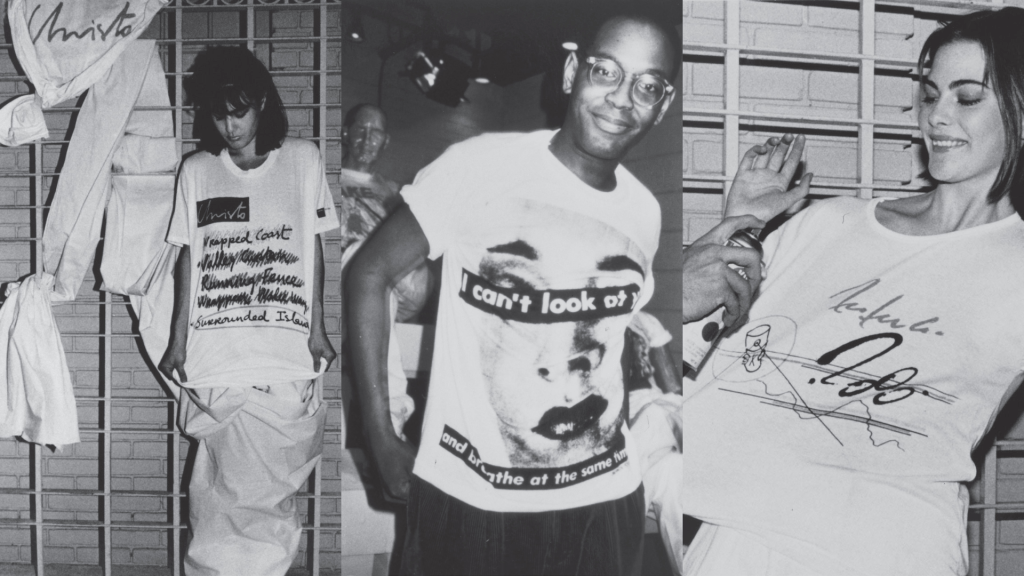
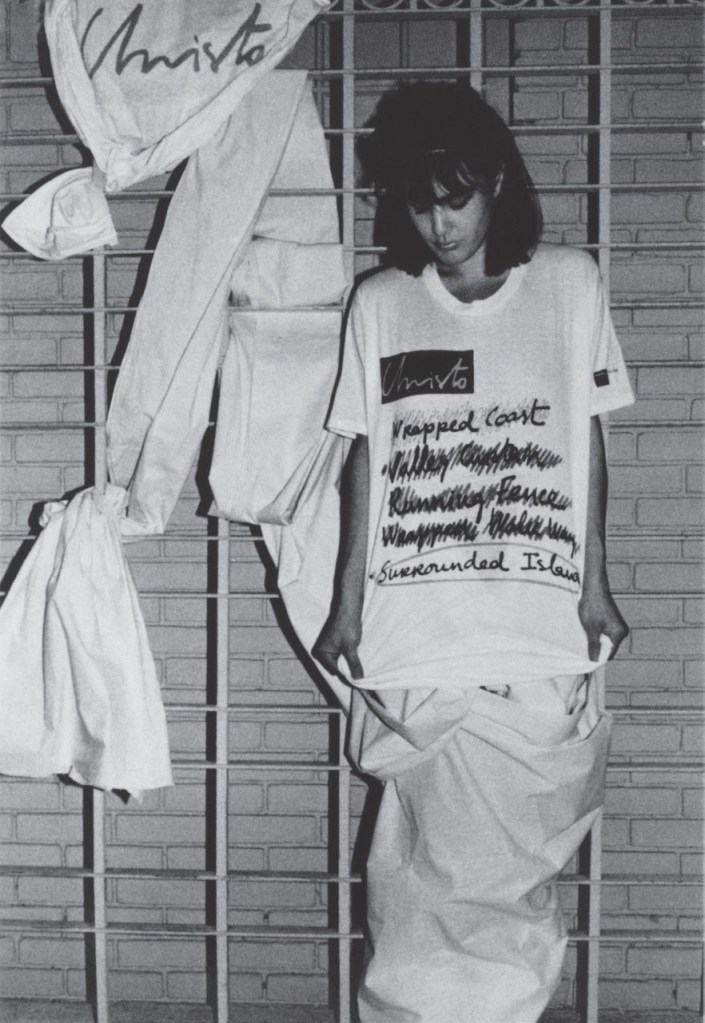
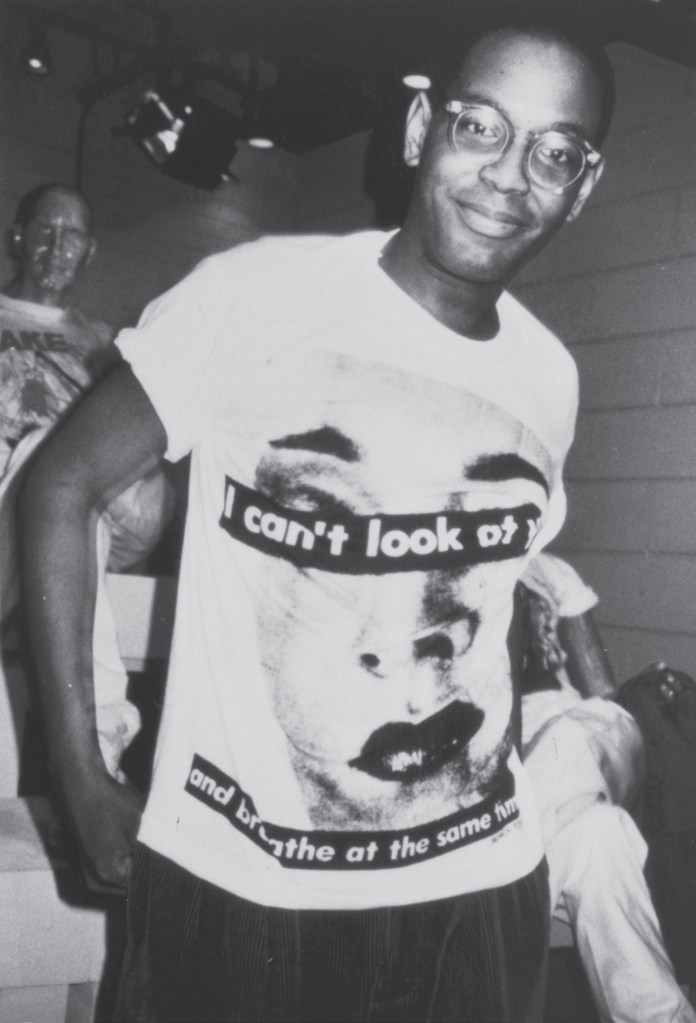
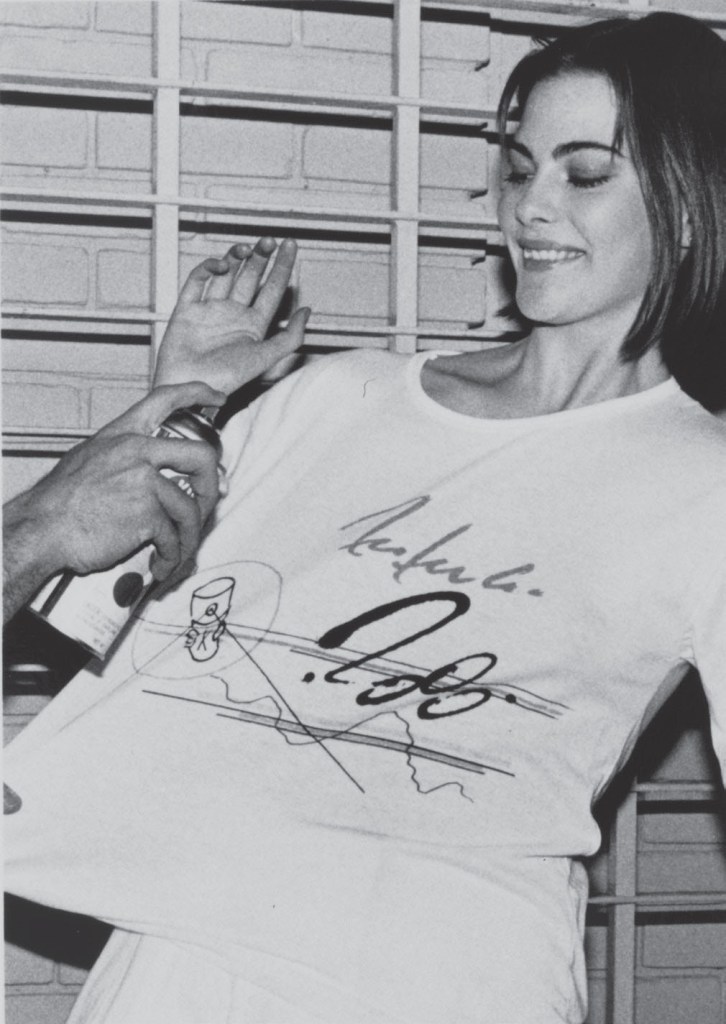
Willi Smith [1948–1987] was considered to be the first African American designer to be the most commercially successful reaching a broad ready-to-wear audience and mainstream retail channels. He was revolutionary in creating seasonless and gender-neutral clothing. He pioneered unprecedented collaborative artistic output across diverse creative channels, exposing art on a mass scale to the public; for example, the first to capture the T-shirt as an art wave, with prominent visual artists like Christo, Keith Haring and Barbara Kruger.*

J. Wesley Tann [1928-2012], recognized for his ‘pioneering contributions’, mentorship of Black designers, and the establishment of the highly successful Wesley Tann, Inc. in 1961, has a street in Newark, New Jersey, named after him. He created fashionable pieces for Diahann Carroll, designed gowns for opera diva Leontyne Price, sketched maternity ensembles for the late Jackie Kennedy-Onassis, and proposed a high-waisted sheath gown for First Lady Michelle Obama’s Inauguration wardrobe. His designs were known for elegance and exquisite construction and sold to I. Magnin, Henri Bendel, Neiman Marcus, B. Altman, Lord & Taylor, among others.
Other Notable Designers
Furrier James McQuay, jewelry designers Bill Smith and Arthur ‘Art’ Smith (not related), Ruby Bailey, Jeffery Banks, Alvin Bell, James Daugherty, Dapper Dan, Jon Haggins, Ola Hudson, and Jon Weston.
III. First Black Fashion Photographer
Gordon Parks [1912-2006] accomplished many firsts, including the distinction of being the first Black photographer at Vogue, Glamour, and Life magazines.
Parks worked at Life for nearly 25 years and completed over 300 assignments. He was a documentary and fashion photographer; a film director, writer, producer; a poet, novelist, essayist; and a composer. Among his notable films are Shaft and The Learning Tree.
Photo credit: The Gordon Parks Foundation

IV. First Black Supermodels
In March 1966, Donyale Luna [1945–1979] became the first African American model to grace the cover of the British edition of Vogue. Luna also became the first Black fashion icon, in 1967 her face and form inspired the first black mannequin. Her modeling career was launched in January 1965 when Harper’s Bazaar featured a line-drawing sketch of Luna on its cover, by the top editorial illustrator, Katharina Denzinger. The mid-sixties were a time when fashion magazines were not inclined to photograph Black women, let alone feature them on their cover. In fact, the Harper’s Bazaar 1965 cover, in sketch form, showed ambiguity as to her racial identity. In British Vogue’s March 1966 cover, the image is obscured, with her hands covering lips and mouth [feature article image]. Luna went on to attain superstar status with Harper’s legendary fashion photographer, Richard Avedon, and in Europe she was photographed by the legendary David Bailey of Beatles and Rolling Stones fame.

Naomi Ruth Sims, [1948–2009], is widely credited as the first African-American supermodel.
A businesswoman and author, Sims was the first African-American model to appear on the cover of Ladies’ Home Journal, November 1968, and Life Magazine, October 1969. Sims retired from modeling in 1973, created a successful multi-million-dollar beauty empire including a wig collection, and authored several books on modeling, health, and beauty.
Beverly Johnson [born 1952] is a model, actress, singer, and businesswoman who is famously known as the first African American model on the cover of American Vogue in 1974. Prior to that, she was the first African American on the cover of Glamour in 1971, which set record sales and circulation, and went on to appear on six more Glamour cover issues. Johnson’s Vogue popularity placed her again in a June 1975 special “American Woman” edition and the first African American on the cover of Elle, a leading French magazine.
Timeline: First Black Supermodels to Appear on the Cover of Major Magazines
- January 1965 – Luna, Harper’s Bazaar, illustration cover
- March 1966 – Luna, British Vogue cover
- November 1968 – Sims, Ladies Home Journal cover
- October 1969 – Sims, Life Magazine cover
- July 1971 – Johnson, Glamour cover
- August 1974 – Johnson, American Vogue cover
- June 1975 – Johnson, French Elle cover
Top Models and Muses, 1960s, 70s, & 80s
Martinique-born Mounia Orosename made history on the Haute Couture runways in the 1970s and 80s, and was Yves Saint Laurent’s first Black muse. It’s a tradition for a muse to open and close a runway show.
Other notable muses: Gloria Burgess at Hanae Mori, Alva Chinn and Pat Cleveland at Halston, and Givenchy’s all-Black cabine.
Because of their contribution to fashion history and, in particular, the Battle of Versailles fashion show in France, Black models—Billy Blair, Jennifer Brice, Alva Chinn, Pat Cleveland, Charlene Dash, Norma Jean Darden, Bethann Hardison, Barbara Jackson, Ramona Saunders, and Amina Warsuma—have been honored in numerous ways in recent press, to name a few: Huffington Post Game Changer Awards, a tribute luncheon by The Metropolitan Museum of Art, Deborah Riley’s film documentary Versailles ’73: American Runway Revolution, and Made to Measure [M2M] film documentary Battle At Versailles: The Competition that Shook the Fashion Industry.
More Models Who Shaped Fashion History
Dorothy Towles Church, Renée Gunter, Sara Lou Harris, Helen Williams Jackson, China Machado, Iman, and Veronica Webb.
V. Blacks Break Barriers
The Coleman Manufacturing Company (1899–1904) was the first African American owned and operated cotton textile mill. To promote the economic security of Black people, it was established in 1897 by Warren Clay Coleman and other Black capitalists in the Piedmont area near Concord, North Carolina.
Ophelia De Vore-Mitchell [1921-2014], one of the first African American models in America in 1938 at the age of sixteen, who founded Grace Del Marco Model Agency and the Ophelia De Vore School of Self-Development and Modeling in New York City in the 1940’s, paved the way for models of color. Her modeling agency and “charm” school was a big deal during that time, helping the Black community present themselves.
Dorothy Towles Church [1922–2006] was the first Black student at Los Angeles’ Dorothy Farrier Charm and Modeling School and the first Black model accepted into the world’s top fashion houses in Paris, which started when one of Christian Dior’s house models was on vacation. She modeled in Paris for five years, in the early 1950’s, for Dior, Elsa Schiaparelli, Robert Piguet, Jacques Fath, and Pierre Balmain.
The National Association of Fashion and Accessory Designers (NAFAD) was founded by Mary McCleod Bethune-Cookman (founder of the National Council of Negro Women) and Jeanetta Welch Brown in 1949 in New York City. NAFAD was trade group designed to create bridges between Black fashion industry professionals and manufacturers, the press, and the world of Seventh Avenue designers and couturiers.
Eunice Johnson
Certain designers assumed that White women wouldn’t value their designs if they were worn by Black women.
-John H. Johnson, founder, Johnson Publishing Company, Chicago History Museum, “Inspiring Beauty: Fifty Years of Ebony Fashion Fair” exhibition catalogue, 2013
Eunice Johnson [1916-2010] was co-founder of the Chicago, Illinois-based Johnson Publishing Company, publisher of Jet and Ebony magazines, and founded Ebony Fashion Fair. Ebony Fashion Fair, which began its five-decade run in 1958, brought fashion to Black society. It was significant in advancing Black culture’s importance in the American story of fashion, and its empowering effect on the Black community. Johnson altered a historical trajectory that defied the odds, broke down the barriers of couture and high fashion targeted exclusively for whites.
Eunice Johnson at work, 1970. Credit: Chicago History Museum

Lois K. Alexander-Lane [1916-2007] founded the Harlem Institute of Fashion in 1966 and Black Fashion Museum in 1979. In 2007, Alexander-Lane’s daughter donated the museum’s collection to the National Museum of African American History and Culture.
The Black Mannequin. The New York Times reported that during the early 1960s, the United States witnessed, for the first time, the introduction of Black mannequins in department stores. “A leading American mannequin manufacturer delivered the first Negro mannequin to a large New York area store—Bamberger’s (owned by Macy’s), Newark … Rich’s, a large Atlanta department store chain, placed an order for Negro mannequins. Meanwhile, South Africa has just announced a ban on the use of black mannequins in department‐store windows.” In 1964, Bergdorf Goodman on Fifth Avenue, displayed black and white mannequins for their back-to-school fashion window for kids, the first in Manhattan.
In the late 1960s, Women’s Wear Daily reported that, for the first time, Black models were featured in Neiman Marcus’ Christmas Book, noting the absence of any protests.
Chicago’s South Center Department Store was known as America’s largest Black-owned department store, when owner S.B. Fuller purchased the store in the early 1960’s.
Battle of Versailles Fashion Show, 1973, hosted at the Palace of Versailles in France, [Battle of Versailles: ‘This Was the Real America, An America They Haven’t Seen’], marked a significant turning point in the history of American fashion.
The United States emerged victorious in ‘the battle,’ effectively placing Black contributions at the forefront of American fashion on the global stage. This event represented a pivotal moment for the fashion industry in America, for African American models, as well as for the esteemed African American designer, Stephen Burrows, whose brilliant colors, signature lettuce-leaf hem, and uninhibited body-conscious designs stunned the French. The “battle” was five French designers: Yves Saint Laurent, Pierre Cardin, Emanuel Ungaro, Christian Dior, Hubert de Givenchy pitted against five American designers: Oscar de la Renta, Halston, Bill Blass, Anne Klein, and Stephen Burrows.
Out of 36 American models, 10 were African American, who projected their personal charisma, dance-performance movements, and enlivenment that electrified the audience. The American runway was a display of seduction with ease and freedom against a minimal stage design, in contrast to the grandeur French traditional, elaborate sets, and theatrical-style presentation. Exposing Black talent, Stephen Burrows and the models, was notable and unusual for the times, and arguably was the basis for this game changing historical moment.
Sources, Suggested Further Study:
- Rhonda P. Hill, A Study of Eight, The Untold American Story, PixxiBook, 2021
- Tonya Blazio-Licorish, Tara Donaldson, WWD Black In Fashion, 100 Years of Style, Influence & Culture, Union Square & Co., 2024
- Edited by Elizabeth Way, Black Designers in American Fashion, Bloomsbury, 2021
- Christine Checinska, Victoria & Albert Museum curator, at home: Artists in Conversation | Hylan Booker, Yale Center for British Art, 18 March 2022 – https://youtu.be/5JjPNt-ENTM
- The Met, The Fashion of Arthur McGee, 8 September 2009, YouTube, https://youtu.be/Uif8yUbPu6Q?si=qtDtWc-3ptuq48YR
- Iris Haastrup, In Search of Our Mother’s Garments, Essence magazine, 20 November 2023
- The groundbreaking Black models who changed fashion, produced as part of “NAOMI in Fashion”, Victoria & Albert Museum, 2024/2025
Feature Image:
*New York 1984 Williwear Productions launched an innovative artist’s collaboration, the first Artventure—the artist t-shirts, a juxtaposition of provocative art with the most basic piece of clothing. The eclectic array of artist-designed t-shirts debuted at Ronald Feldman Gallery.
(l-r) Christo, Kruger—Willi Smith is wearing Barbara Kruger, Futura. Photos courtesy of the New York Cooper Hewitt Education Department. Source Smithsonian Learning Lab.
 E D G E