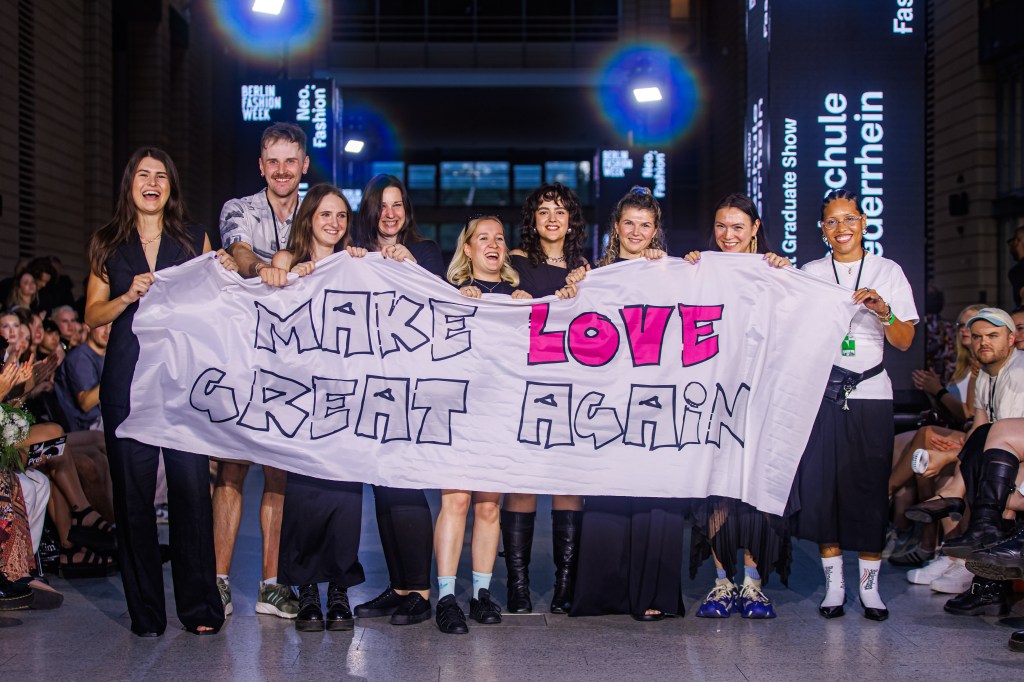
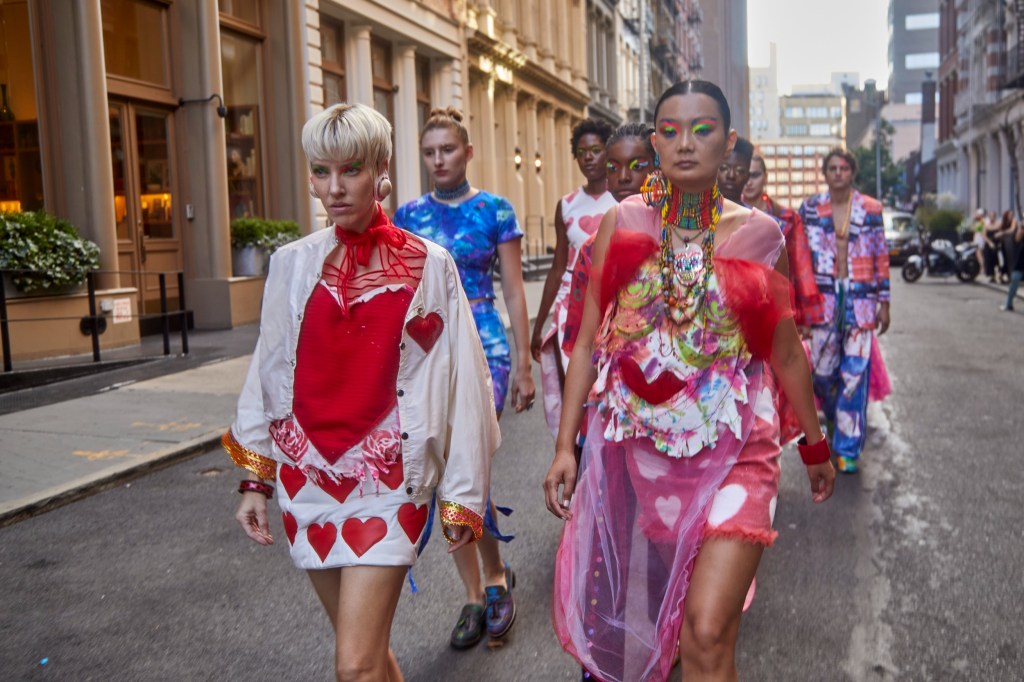
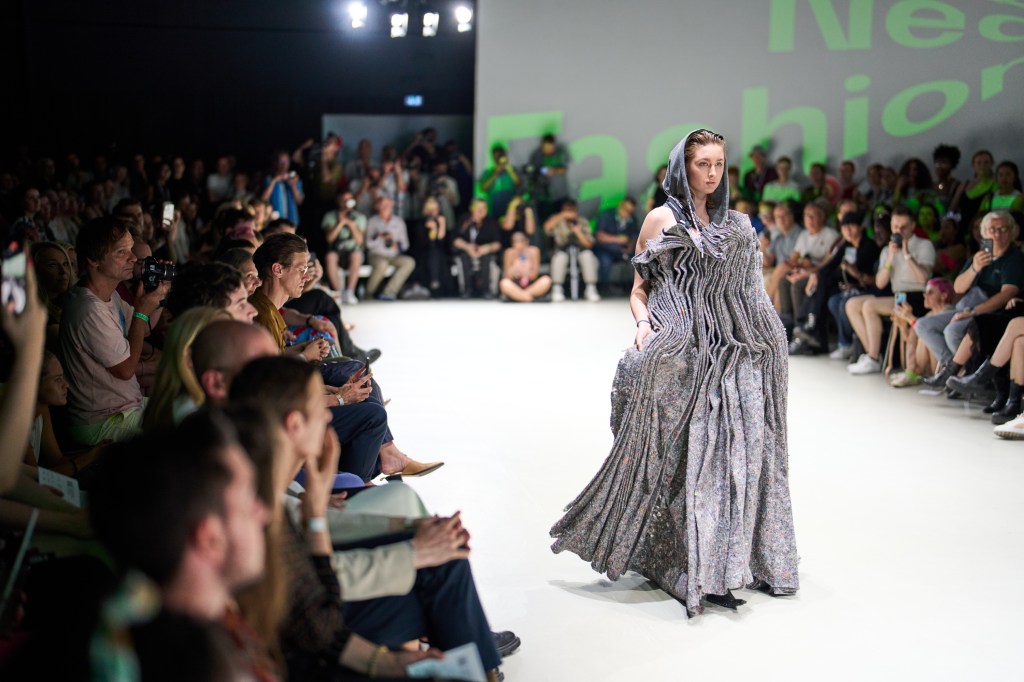
Fashion design students, from Niederrhein University of Applied Sciences, Germany, walked the runway at Neo.Fashion.25, Berlin Fashion Week with the sign Make Love Great Again. Fashion serves as a visual record of history’s most pivotal moments. What does this message say about the times we live in? Does it represent hope and resiliency in today’s global polycrisis; as we face climate emergency, deep social division, potential political realignment, increasing wealth gap, and war?
What’s influencing the work of design students and graduates? What are their concerns, challenges, and outlook on the future? What’s the underlying tone of their inspiration? Twenty-two year old Amelie Vaupel, who is studying fashion design at Macromedia University in Germany, voices what influences her, “I see design as a living, open process—intuitive, experimental, and always in relation to the world around me.”

Recent data from global and national polls, such as the Harvard Youth Poll and the European Commission and Council of Europe youth platform, reveal that young people are feeling profoundly disillusioned and pessimistic about world politics. The United Nations global survey found that 76% of young respondents under 30 believe politicians do not listen to them. They have low trust in institutional politics, perceiving the system as failing to address their concerns. This has led to a redefinition of political engagement, with many youths moving away from traditional forms of participation toward issue-driven activism, often facilitated by social media.
Art indisputably plays a crucial role in navigating and responding to crises, both mirroring social realities and guiding social change. Throughout history, artists have produced powerful works that effectively capture the unique challenges faced by communities during periods of global, national, and local upheaval. While youth are often viewed as essential catalysts for change, how does their disengagement affect creativity and their capacity for innovation?
Clothing is not only about aesthetics—it is a manifesto. It is a form of soft power capable of transmitting ideas, emotions, and generational narratives.
Anastasiia Navrotska
As I have toured and reviewed graduate students’ work this year, I consistently observe compelling themes that resonate powerfully with current socio-political trends; three of which stand out the most are world instability and uncertainty, imagined in Yuval Sortzkin’s Work in Ruins, social anxiety, as manifested in the work of Amelie Vaupel, and mental health, especially with regards to those affected by war, depicted in the innovative work of Ukrainian designers Anastasiia Navrotska and Alina Hnidenko. Their concern for these far-reaching issues is the emotional core that shapes their body of work. Moreover, the combination of research, experimentation, and critical thinking yields thought-provoking artistic output; with a bold essence of design, beautifully captured by Ukrainian designer Anastasiia Navrotska, who affirms, “Clothing is not only about aesthetics—it is a manifesto. It is a form of soft power capable of transmitting ideas, emotions, and generational narratives.”
World instability and uncertainty
I wanted to explore what it means to redefine stability in a time of uncertainty.
Yuval Sorotzkin
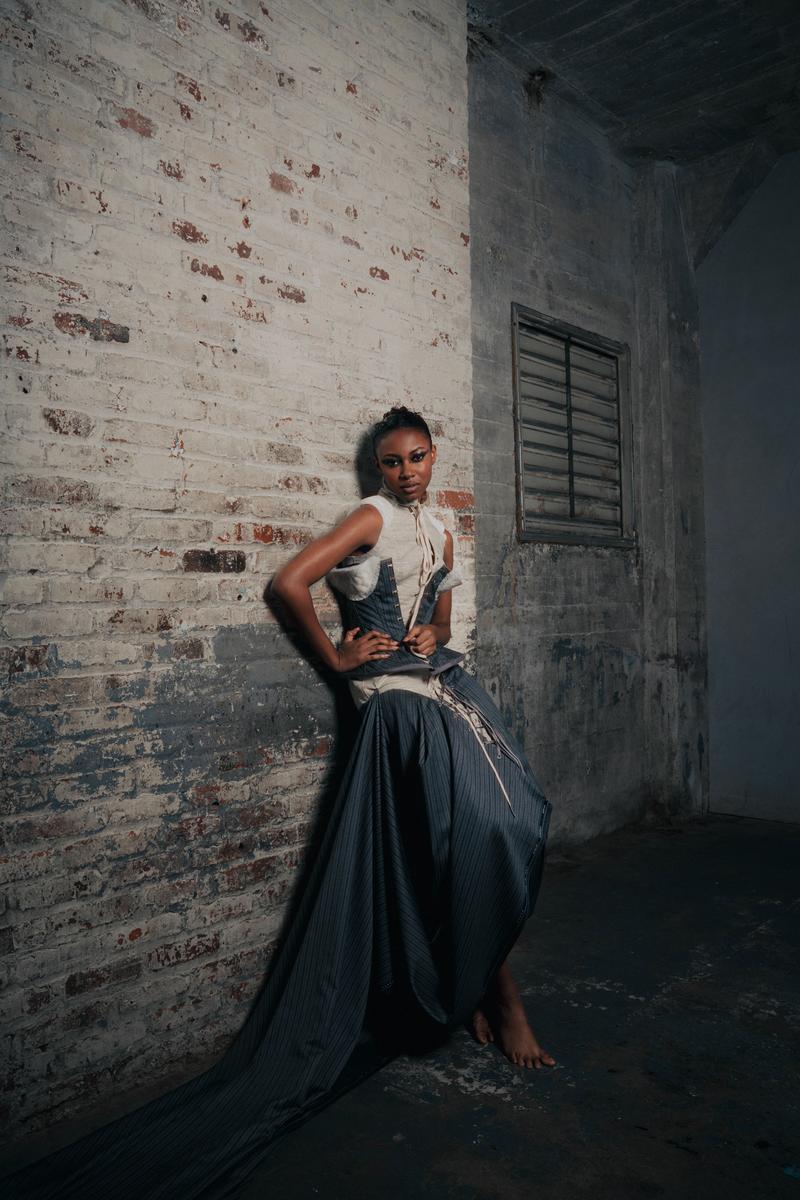
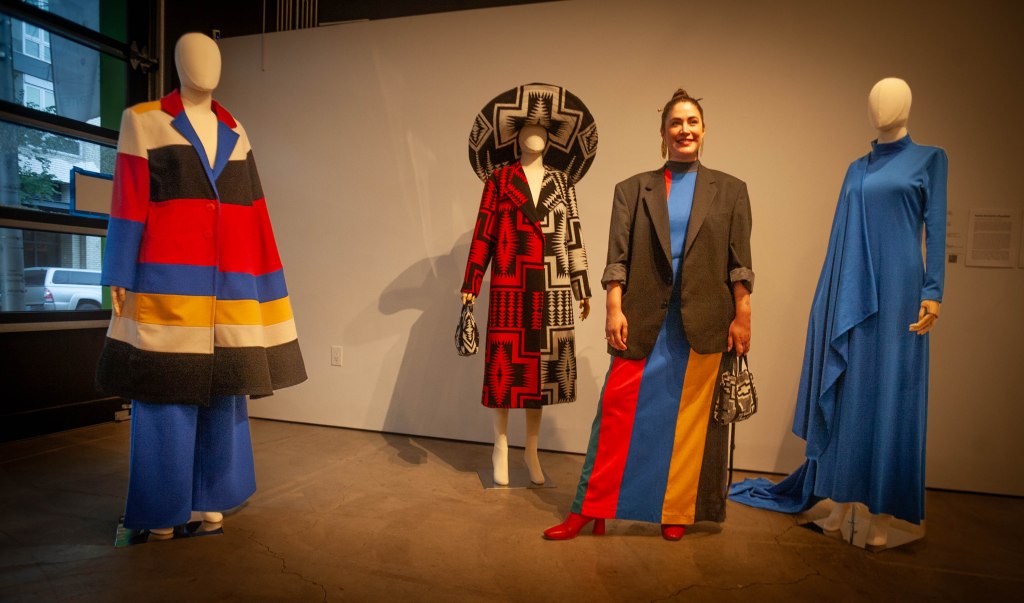
Raised by immigrant parents and speaking three languages, Yuval Sorotzkin is a New York-based artist whose interdisciplinary practice centers on fashion-oriented design. She holds a BFA in Fashion Design from the Fashion Institute of Technology, where she was awarded the Critic Award for “Work in Ruins”. She has also studied at Politecnico di Milano and Shenkar College.
Work in Ruins explores the relationship between vulnerability and creation in a volatile world, using fashion as a medium to examine resilience and adaptability. Sorotzkin deconstructs and reimagines traditional garment-making techniques, exposing raw construction elements to reflect themes of instability and reconstruction. Drawing from a background in construction and influenced by multifaceted social, political, and environmental shifts, her work artfully bridges personal experiences with broader global issues.


Sorotzkin describes her emotional introspection for composing a body of work where she aimed to challenge conventional notions of security, “By transforming emotions into abstract design elements, I wanted to explore what it means to redefine stability in a time of uncertainty.” Each piece should serve as a dialogue, a reflection, inviting the viewer to engage in their own understanding of stability amidst a world of uncertainty.

War, mental health, and social anxiety
Drawing from their unique experiences and resilience, the Ukrainian designers reflect on the war, loss, and the aftereffect of mental illness. They channel their emotions into creative expressions that not only capture the harsh realities of conflict but also showcase the beauty of hope and perseverance amidst despair. By blending traditional elements with contemporary designs, these artists create powerful narratives, transforming pain into a source of inspiration and healing.

World Economic Forum reports that the world’s 1.2 billion young people—16% of the global population—stand at a crossroads. Young people worldwide are facing a generational mental health crisis. The Ukrainian designers’ work serves as a reminder of the strength we see in the their people and the importance of mental well-being during warfare, fostering a dialogue around the intersection of art and trauma.
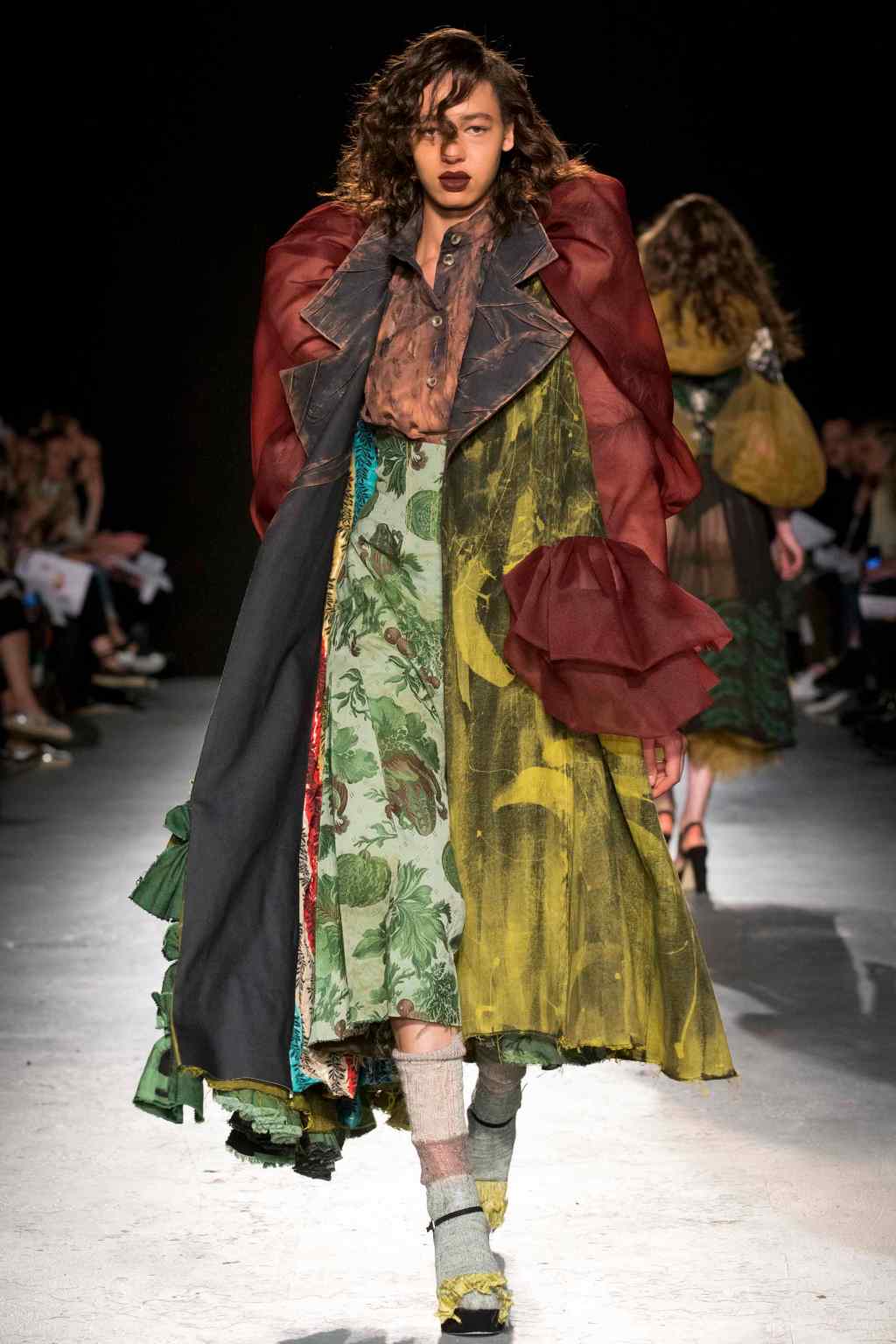
Anastasiia Navrotska’s collection, Ars Vulnerata, reframes the role of contemporary fashion. It challenges the conventional view by asserting that fashion can and should confront our most difficult realities: war, recovery, memory, and an uncertain future. The collection serves as a compelling exploration of war’s profound consequences for the individual, and how that trauma ripples through culture, art, and the nation itself.

“The human psyche is a strange thing,” says Navrotska about her collection. “Some are shattered by the slightest breeze, while others withstand the storm. Many flaunt minor ‘mental flaws’ while hiding deeper wounds behind a smile. This collection is a call to acknowledge our internal struggles—because recognition is the first step toward healing. But mental health is just one of the many consequences of war—present now and looming in the future.”
Ars Vulnerata, Anastasiia Navrotska, Neo.Fashion.2025 at Berlin Fashion Week, July 2025 | photo: Robert Schlesinger, @RobertSchlsinger, courtesy of Neo.Fashion.2025
“A year ago, my boyfriend died in the war and one person told me, ‘you will meet one day between the earth and the sky’,” says Alina Hnidenko, whose collection, Between Earth and Sky, is deeply personal due to the pain of her loss. “It is a garden for a meeting, in which there are no restrictions, no rules, only feelings, passion and hope. All the details of the collection convey my different stages and states that I have gone through this year.”


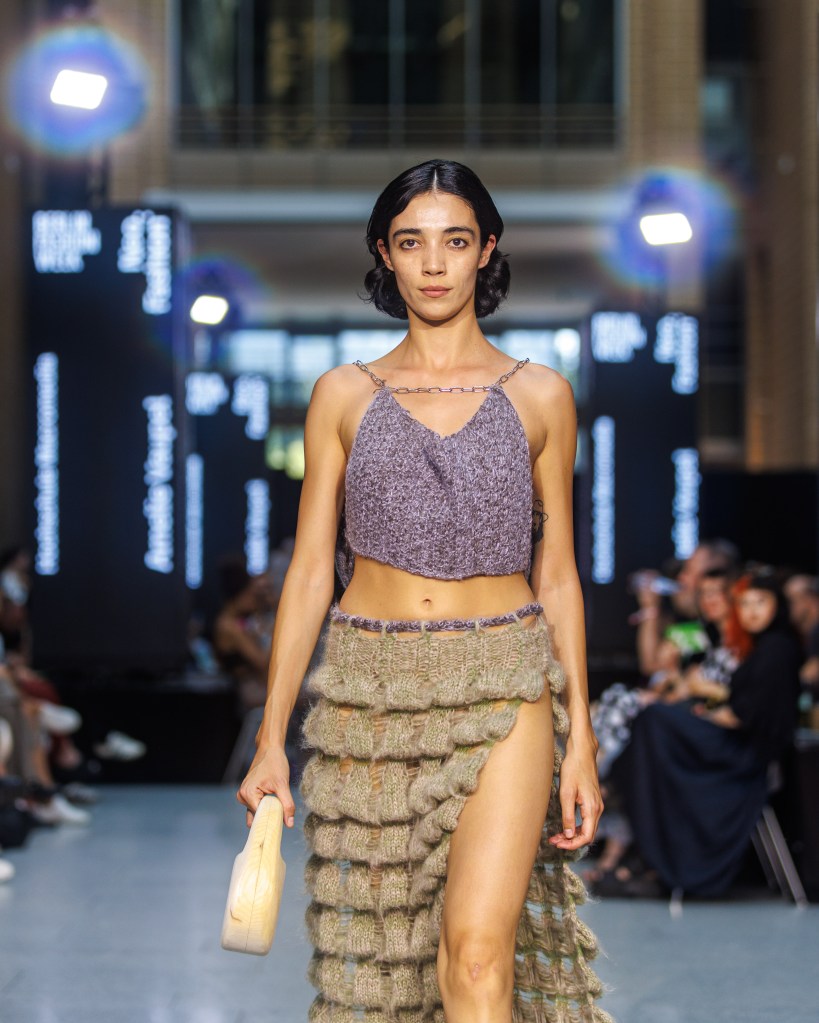
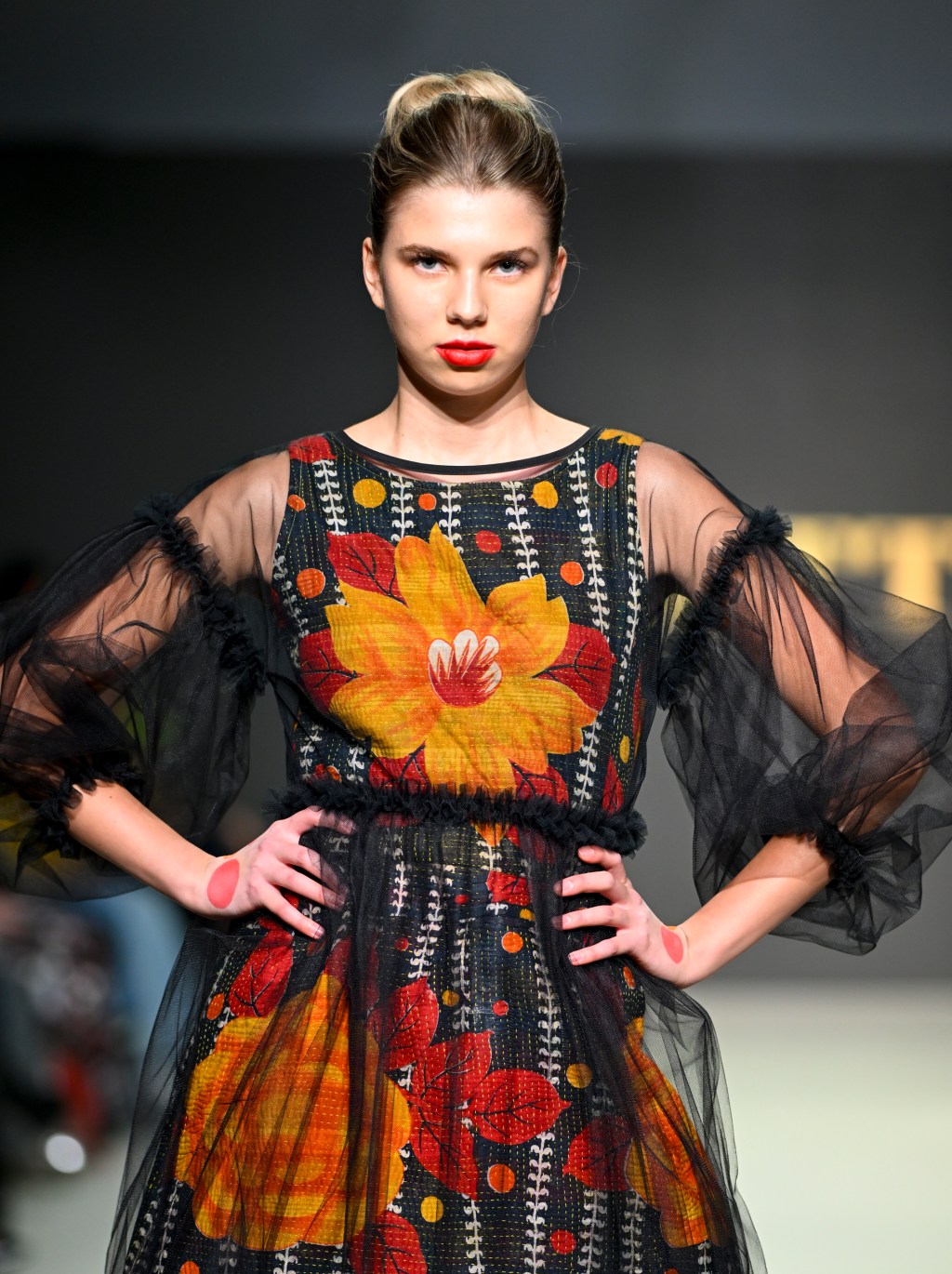
For her collection, But Even Storms Pass, Amelie Vaupel uses knitting as her core design language. Her work is an intensely personal exploration of social anxiety, capturing the inner conflict of feeling overwhelmed and withdrawn while still having the desire to be seen.
Through knitting, Vaupel gains the freedom to orchestrate a complex interplay of density, transparency, texture, and shape. This creative process is more than an assembly of fashion; it is a therapeutic act that explores the tension between emotions of protection and vulnerability. The resulting textile ensemble, one could argue, reflect the storm of social anxiety felt within, while also holding the hope that, like all storms, it will eventually subside.
“This collection is a journey—through fears, through silence, through courage. And in the end: calm arrives. The storm passes. Left behind are fine traces—delicate scars but also roots newly taken hold. Each outfit tells one of these stories.” – Amelie Vaupel
But Even Storms Pass, Amelie Vaupel, Neo.Fashion.2025, Berlin Fashion Week, Potsdamer Platz, 02 July 2025 | photo: Gerome Defrance, @defrance.images

Crisis can spark a wave of creativity, as beautifully illustrated in the inspiring works of Hnidenko, Navrotska, Sortzkin, and Vaupel, motivating us to unite in a powerful call for transformative change and a hopeful vision for a future we can truly embrace.
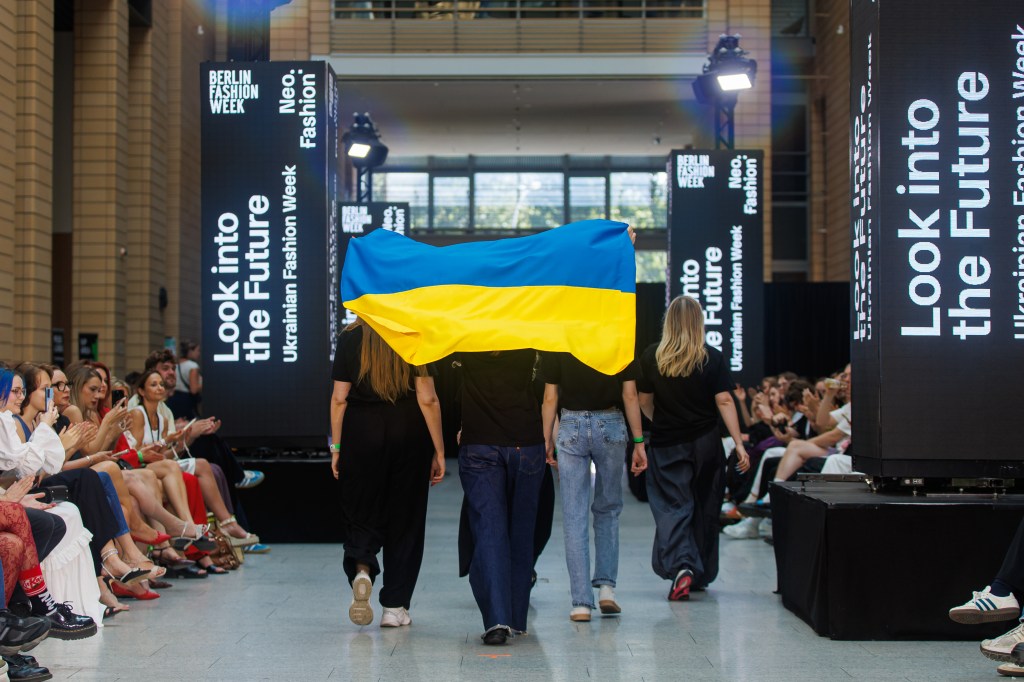
Feature image: Fashion Students from Niederrhein University of Applied Sciences, Germany, walk the runway at Neo.Fashion.2025, Berlin Fashion Week, Potsdamer Platz, 02 July 2025 | photo: Gerome Defrance, @defrance.images
 E D G E